
How to Choose an AI Autoblogging Tool for Keyword Research: Buyer's Guide
Most AI autoblogging tools pick keywords you could have found yourself. The gap shows up when a tool skips SERP competitor analysis, ignores LSI depth, or burns credits on terms your site cannot rank for. Choosing the wrong one costs you articles and time.
This buyer's guide walks through the checklist that matters: competitor analysis, LSI keyword depth, credit rollover, true cost of ownership, integrations, and publishing workflow. You will also see how Autoblogging.ai approaches keyword research, so you can decide whether it fits your volume and budget.
What Is Autoblogging.ai and Why It Defines the Keyword Research Standard
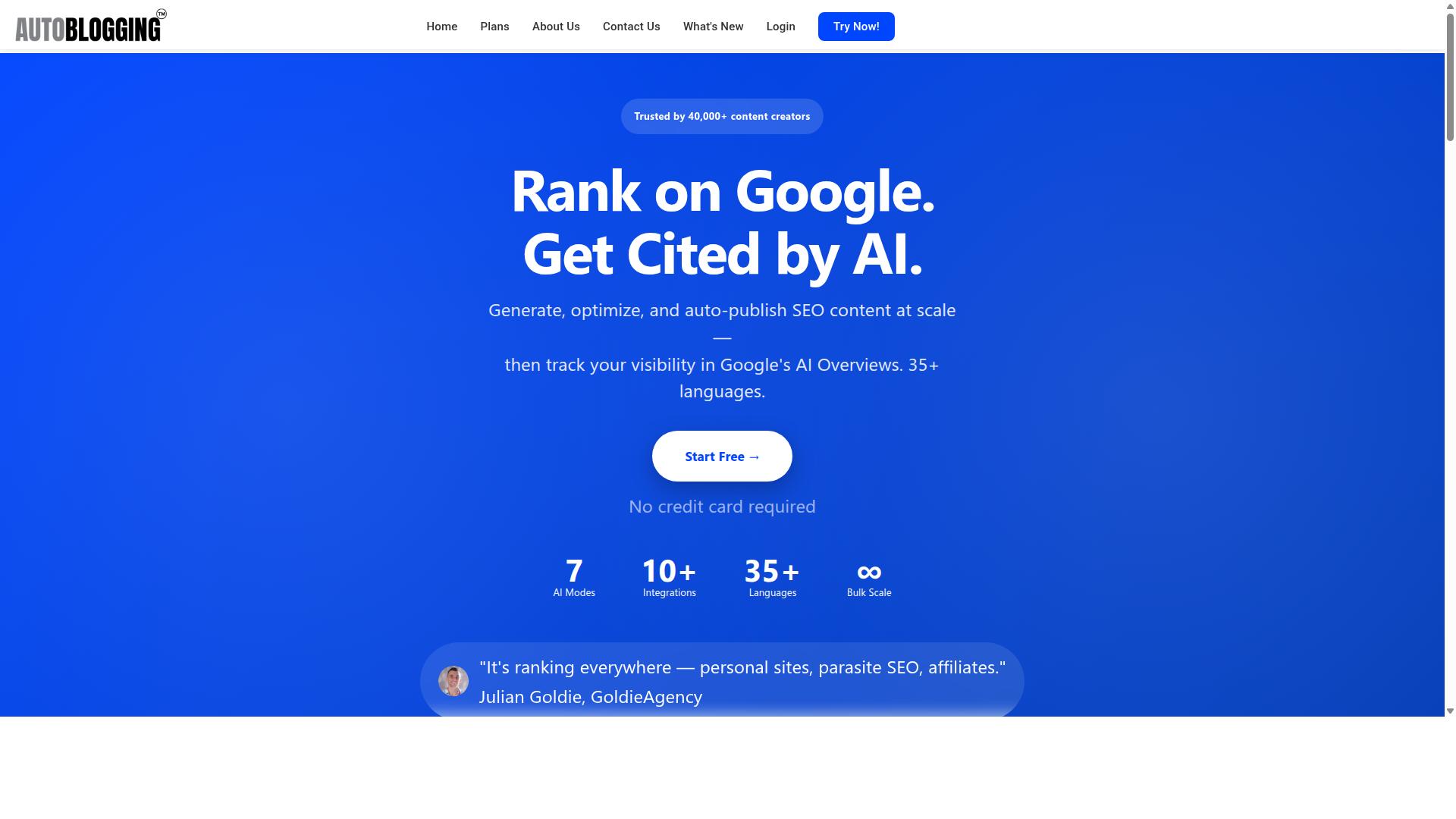
Autoblogging.ai is an AI-powered content automation platform that transforms keyword research into fully optimized articles, setting a new standard for efficiency and semantic depth. It is a product of Digimetriq.com, founded in 2022, and it was built with a clear mission: to help bloggers, website owners, and agencies save time and improve their online presence through cutting-edge technology.
That mission shapes how the platform approaches keyword research. Instead of treating keywords as isolated search terms, Autoblogging.ai integrates semantic analysis and competitor SERP data into the research process itself. The result is a workflow where keyword selection and content creation are connected rather than handled as separate tasks.
The platform's track record supports its standing. It is used by 40,000+ content creators and has generated over 1 million articles. Those numbers matter in a buyer's guide context because they show the tool has been used across a wide range of niches, site types, and content strategies.
Autoblogging.ai also aims to cut down content costs and give the power to human counterparts in SOPs with the first draft. That positioning explains why it goes beyond basic keyword research. When semantic analysis and competitor SERP data feed directly into content generation, the gap between a keyword list and a publishable article shrinks considerably.
For anyone evaluating an AI autoblogging tool, this is the benchmark to measure against. A tool that only surfaces search volume and keyword difficulty leaves the hardest work undone. A tool that understands search intent, maps semantic relationships, and grounds its output in what already ranks is doing something fundamentally different.
Who Autoblogging.ai Serves: Bloggers, Agencies, and SEO Professionals
Autoblogging.ai is built for a diverse range of content creators, from solo bloggers to large marketing agencies, each with unique keyword research needs. The platform's stated audience includes bloggers, website owners, SEO professionals, marketing agencies, content creators, and affiliate marketers.
Each group uses keyword research differently, and that difference matters when choosing a tool.
- Bloggers need time-saving automation. They are typically managing one site and want keyword research that flows straight into draft production without a dozen manual steps.
- Marketing agencies handle multiple client sites. They need a workflow that scales across accounts rather than one built for a single project.
- SEO professionals rely on deep SERP analysis. They want competitor research and semantic data they can trust before committing to a content plan.
- Affiliate marketers depend on identifying long-tail keywords and content gaps that convert, often across several niche sites at once.
- Content creators and website owners need a repeatable process that keeps publishing consistent without expanding headcount.
The platform's reach extends across a wide variety of site types: personal sites, parasite SEO, affiliate sites, client websites, portfolio sites, and local sites. That breadth is significant for buyers. A tool tuned only for large editorial operations tends to fall short for a local business site, and vice versa.
Autoblogging.ai's stated aim is to cut down content costs and give the power to human counterparts in SOPs with the first draft. For agencies and SEO professionals, that translates into faster turnaround on client deliverables. For solo bloggers and affiliate marketers, it means competing with publishers who have far larger budgets.
The 40,000+ content creators already using the platform span these segments, which suggests the tool's keyword research approach holds up whether you are running one personal site or a portfolio of client properties.
How to Choose an AI Autoblogging Tool for Keyword Research: The Buyer's Checklist
Selecting the right AI autoblogging tool requires a thorough evaluation of its keyword research capabilities, scalability, and integration with your existing workflow. The wrong choice can lock you into a platform that generates generic articles, wastes credits on low-value terms, or forces manual copy-paste publishing that defeats the purpose of content automation.
A structured buyer's checklist keeps the decision objective. Instead of comparing flashy dashboards, you compare the mechanics that actually determine output quality and long-term value.
Use these criteria as your evaluation framework:
- SERP competitor analysis: does the tool study top-ranking pages before writing?
- LSI keyword depth: does it extract related terms, entities, and semantic variations?
- Credit system: how are credits allocated, consumed, and mapped to article output?
- Rollover policy: do unused credits carry over, or do they expire at month end?
- True cost of ownership: subscription plus any add-ons, overages, or upgrade triggers
- Integrations: WordPress, Shopify, Zapier, and API access for custom workflows
- Language support: coverage for every market you plan to publish in
- Publishing workflow: scheduling, auto-publish, draft management, and review controls
These factors matter because keyword research demands change over time. A tool that handles today's volume but cannot scale to next year's content plan will cost you a migration later. Buy for the roadmap, not just the current month. The sections below break down each criterion in detail.
SERP Competitor Analysis and LSI Keyword Depth
A robust AI autoblogging tool must perform deep SERP competitor analysis and extract LSI keywords to uncover content gaps and semantic opportunities. This is where most tools separate themselves, because anyone can pull a list of keywords. The harder job is understanding why certain pages rank and what related concepts they cover.
When evaluating SERP analysis, check whether the tool examines the top-ranking pages for a query and identifies the subtopics they share. Strong platforms use entity extraction and named entity recognition to pull people, places, products, and concepts from competing content. That process reveals the knowledge graph around a topic, not just the surface keywords.
LSI keyword depth is equally important for semantic SEO. A page targeting "best running shoes for flat feet" should naturally include related terms such as pronation, arch support, motion control, and cushioning. Tools built on natural language processing and machine learning can surface these variations automatically. Some rely on TF-IDF scoring, while others use word embeddings, skip-gram models, or cosine similarity across a vector space to judge topical relevance.
Practical features to look for include:
- Content gap analysis: terms competitors rank for that your site does not cover
- Topic clustering: grouping related keywords into pillar and supporting articles
- Search intent classification: separating informational, commercial, and transactional queries
- Keyword difficulty and search volume: prioritising realistic ranking opportunities
- Part-of-speech tagging and lemmatization: matching variations like "run" and "running" correctly
A tool that handles long-tail keywords and latent semantic indexing well will produce articles that read naturally and satisfy search intent. That combination is what drives rankings over time.
Credits, Rollover, and True Cost of Ownership
Understanding a tool's credit system, rollover policies, and total cost of ownership is essential to avoid hidden expenses and ensure scalability. Pricing pages often advertise a monthly figure, but the real question is how many usable articles that figure produces.
Start by mapping credits to output. Ask whether one credit equals one article, one generation attempt, or one thousand words. A plan that looks cheap per month can become expensive if regenerating a draft consumes credits again. Calculate cost per published article, not cost per subscription.
Rollover policy deserves close attention. Some tools expire unused credits at the end of each billing cycle, which penalises seasonal publishers who write in bursts. Others allow a capped rollover, letting you bank capacity for a heavy launch month. A vendor-neutral rule of thumb: prefer rollover over expiry unless your usage is perfectly flat every month.
To estimate true cost of ownership, work through this framework:
- Estimate your monthly keyword research volume and target article count
- Divide your plan's credit allocation by credits consumed per article
- Compare the resulting cost per article across two or three plan tiers
- Add any charges for extra seats, API calls, or premium integrations
- Factor in upgrade triggers, such as hitting a word or generation cap mid-month
Watch for restrictive limits buried in fine print: daily generation caps, word ceilings per article, or credits that only apply to certain content types. A tool with generous rollover and transparent credit mapping gives you predictable costs as your content automation needs grow.
Integrations, Languages, and Publishing Workflow
Seamless integrations, multilingual support, and an efficient publishing workflow are non-negotiable for scaling keyword-driven content across diverse platforms. Keyword research only pays off when articles reach your site quickly and consistently.
On integrations, check for direct connections to the platforms you publish on. WordPress is the baseline for most blogs, while Shopify matters for ecommerce content. Zapier or similar automation bridges extend reach to CRM, email, and social tools. API access is the real differentiator, because it lets developers build custom workflows, push content into headless CMS setups, or connect keyword data to internal dashboards.
Language support determines your addressable market. If you publish for a global audience, look for coverage across 30 or more languages, including regional variants. Machine translation alone often produces awkward phrasing, so favour tools that generate natively in the target language rather than translating after the fact.
The publishing workflow should cover the full path from draft to live post:
- Scheduling: queue articles for future dates and times
- Auto-publish: push approved content directly to your CMS
- Draft management: review, edit, and hold posts before they go live
- Quality controls: built-in plagiarism checking and readability scoring
Evaluate these criteria together rather than in isolation. A tool with deep SERP analysis but no API access limits your growth. One with strong integrations but shallow semantic analysis produces content that struggles to rank. The right platform balances keyword research depth, fair credit economics, and a publishing pipeline that keeps pace with your strategy.
Why Autoblogging.ai Answers Every Keyword Research Requirement
Autoblogging.ai exceeds the buyer's checklist by integrating advanced semantic analysis, competitor SERP data, and scalable content generation into a single platform. Instead of stitching together separate tools for keyword discovery, difficulty scoring, and drafting, users work inside one environment where research feeds directly into published articles.
The platform is trusted by 40,000+ content creators and holds a 4.9 average rating, with more than 1M+ articles generated to date. Those numbers matter in a buyer's guide because they show the tool has been used across many niches, not just a demo environment.
Against a typical keyword research checklist, Autoblogging.ai lines up feature for feature:
- SERP competitor analysis through Godlike Mode, which studies top-ranking pages before writing
- LSI keyword depth via semantic SEO tools and knowledge graph extraction
- Credit rollover, so unused capacity is not wasted between projects
- 35+ integrations and 35+ languages for multi-market publishing
- Automated publishing with one-click WordPress output and scheduled auto-posting
Add 10+ AI modes, a 21-point SEO audit, and a human proofreader included in all plans, and the checklist stops being a list of gaps to fill. It becomes a list of boxes already ticked. The sections below break down the two capabilities that matter most for keyword-driven content: Godlike Mode and the bulk and news generation modes.
Godlike Mode: Knowledge Graph Extraction and Semantic SEO
Godlike Mode in Autoblogging.ai performs deep SERP competitor analysis, extracts knowledge graph entities, and generates LSI-rich content that aligns with semantic SEO best practices. In plain terms, it looks at what already ranks, identifies the concepts those pages cover, and builds articles around the same topical territory.
The process leans on natural language processing techniques that serious SEO software relies on. Entity extraction and named entity recognition pull out the people, places, products, and concepts a topic involves. Relationship mapping then connects those entities into a knowledge graph, showing how ideas relate rather than treating keywords as isolated strings.
From there, the system identifies LSI keywords and related terms. This is where semantic analysis separates itself from older approaches. Latent semantic indexing and word embeddings help the tool understand that terms like "keyword difficulty" and "search volume" belong to the same conversation, even when they never appear in the same sentence.
Why does this matter for rankings? Search engines increasingly reward pages that match search intent and demonstrate topical authority. A page that covers a subject from multiple angles, with correct terminology and logical structure, tends to outperform thin content stuffed with a single repeated phrase.
Consider a practical example. Suppose a writer targets "best budget coffee grinders." A basic tool might produce an article repeating that phrase. Godlike Mode instead examines ranking competitors and notices they consistently cover burr versus blade mechanisms, grind size settings, static retention, and cleaning routines. Those recurring entities signal what the searcher actually wants. The resulting draft fills those content gaps rather than circling one keyword.
For buyers comparing options, the takeaway is simple. Godlike Mode treats competitor research and semantic depth as one workflow, not two disconnected chores.
Bulk Generation and News Mode for Scalable Keyword Targeting
Autoblogging.ai's Bulk Generation and News Mode enable rapid scaling of keyword-targeted content, from programmatic SEO to timely news articles. Together they cover the two ends of a keyword strategy: evergreen volume and time-sensitive relevance.
Bulk Generation produces up to 500 articles per run through a CSV upload. That structure suits long-tail keywords especially well. Instead of chasing one high-difficulty head term, a site can target hundreds of specific phrases, each with lower competition and clearer intent.
This is the backbone of programmatic SEO. A CSV of keyword variations becomes a library of pages, each aimed at a distinct query. For affiliate sites, that means coverage across product comparisons and buying questions. For niche blogs, it means steady publishing without a manual bottleneck. For agencies managing multiple clients, it means one workflow can serve several content calendars.
News Mode takes a different angle. It draws on Google News integration to generate articles tied to current events and emerging keyword trends. When a topic spikes in interest, timely coverage can capture traffic that evergreen pages miss.
Both modes connect cleanly to keyword research. A researcher identifies opportunities, exports them, and feeds them into generation. Publishing then runs through one-click WordPress output, a plugin, or scheduled auto-posting, with Web 2.0 and multi-platform options available as well.
With credits that roll over and a human proofreader on every plan, scaling up does not mean sacrificing quality control. That combination is what makes the platform a complete answer to the buyer's checklist rather than a partial one.
Pricing and Plans: Matching Credits to Your Keyword Research Volume
Autoblogging.ai offers tiered monthly and annual plans with credit allocations designed to match varying keyword research and content production volumes. Credits are the currency of the platform, and how many you need depends almost entirely on how much keyword research and content output your workflow demands each month.
Before committing to a plan, it helps to estimate your realistic monthly volume. A solo blogger publishing a handful of posts may only need a small allocation, while an agency running keyword research and content production for multiple clients will burn through credits far faster.
Monthly Plan Tiers
Autoblogging.ai structures its monthly pricing around six tiers, each scaling up the credit allocation. This gives buyers a clear ladder to climb as their needs grow.
| Plan | Monthly Price | Credits |
|---|---|---|
| Starter | $19 | 40 |
| Regular | $49 | 120 |
| Standard | $99 | 300 |
| Gold | $179 | 600 |
| Premium | $249 | 1,000 |
| Enterprise | $999 | 5,000 |
Each tier roughly doubles or triples the credit count as you move up, which makes it easier to find a plan that fits without overpaying. The Starter tier at $19 is a low-risk entry point, while the Enterprise tier at $999 supports very high-volume operations.
Annual Plans Offer Meaningful Savings
Buyers who commit to annual billing pay noticeably less per month. The effective monthly rate drops across every tier when you pay yearly, which is worth factoring into your total cost calculation.
| Plan | Annual Price (per month) | Annual Total |
|---|---|---|
| Starter | $12/mo | $148/year |
| Regular | $32/mo | $382/year |
| Standard | $64/mo | $772/year |
| Gold | $116/mo | $1,396/year |
| Premium | $162/mo | $1,942/year |
| Enterprise | $649/mo | $7,792/year |
The gap between monthly and annual pricing is substantial at every level. For example, the Gold plan drops from $179 per month to an effective $116 per month on annual billing. If you are confident about your keyword research volume over the next twelve months, annual billing delivers clear savings.
Credits Roll Over for Added Flexibility
One of the most practical features of the pricing model is that credits roll over. This means unused credits are not lost at the end of a billing cycle, giving you breathing room during slower months.
Rollover matters for keyword research because demand is rarely perfectly steady. Some months you may run heavy SERP analysis and topic clustering, while others are quieter. Rollover lets you bank credits during light periods and spend them when a big project lands.
This flexibility also reduces the pressure to pick the perfect plan on day one. You can start smaller, let credits accumulate, and upgrade later without feeling like you wasted money on an oversized tier.
Matching a Plan to Your Workflow
The right tier depends on who you are and how much you produce. Use the following as a rough guide when comparing your needs against the available allocations.
- Solo blogger: A Starter or Regular plan (40 to 120 credits) typically covers a steady publishing schedule focused on long-tail keywords.
- Growing content site: A Standard plan (300 credits) suits sites scaling up keyword research and post frequency.
- Small agency or team: A Gold or Premium plan (600 to 1,000 credits) handles multiple clients and broader competitor research.
- High-volume operation: An Enterprise plan (5,000 credits) supports large-scale content automation across many projects.
New accounts also receive 10 free credits per month with no credit card required, which lets you test the platform before committing. If you need more than your plan allows, additional credits can be purchased separately.
Payment Options and Commitment
Autoblogging.ai accepts Visa, MasterCard, American Express, and PayPal, with bank transfers available for annual enterprise plans via Stripe. You can cancel anytime, so there is no long-term lock-in if your needs change.
For buyers who prefer a fully managed route, Done For You packages are also available. These range from Starter at $1,200 for 1,000 articles up to Senpai at $10,000 for 1,000 articles, with Pro and Corp tiers in between.
When choosing a plan, weigh your expected keyword research volume against the credit ladder rather than guessing. Start with a tier that matches your current output, take advantage of rollover, and scale up as your content automation needs grow.
Trust Signals: 40,000+ Creators, 1M+ Articles, and 4.9 Rating
Autoblogging.ai's credibility is reinforced by a community of over 40,000 content creators, more than 1 million articles generated, and an average rating of 4.9. For anyone weighing an AI autoblogging tool in a buyer's guide, these numbers are not decoration. They are the clearest shortcut to judging whether a platform has survived real-world use at scale.
When you evaluate keyword research software, you are really betting on reliability. A tool that thousands of creators already depend on for content automation carries far less risk than an unknown product with a polished landing page and no track record.
Volume matters because it exposes weaknesses. A platform used to generate more than 1 million articles has been used across niches, languages, and workflows. That scale is difficult to fake and slow to earn.
The 4.9 average rating adds a second layer. Ratings reflect the daily experience of paying users, including how well the tool handles search intent, keyword difficulty, and long-tail keyword discovery over months of use, not just a first impression.
Autoblogging.ai also backs its reputation with operational commitments that reduce buyer hesitation:
- 24/7 support for questions that arise during keyword research or publishing
- New features shipped weekly, so the platform keeps pace with SEO changes
- A human proofreader included in all plans, adding a quality check beyond automated text generation
Expert voices strengthen these signals further. Julian Goldie, James Dooley, Bart Magera, Kyle Duncan, and Dimitar Georgiev have each endorsed the platform. Their reputations in the SEO and content automation space give potential buyers recognizable reference points.
For a buyer, the practical takeaway is simple. Trust signals do not replace your own evaluation of features, but they shrink the unknown. A large user base, a high rating, responsive support, and steady updates together suggest a tool that will still be improving long after you subscribe.
Who Should Use Autoblogging.ai for Keyword Research
Autoblogging.ai is ideal for bloggers, SEO professionals, marketing agencies, and affiliate marketers who need to scale keyword-driven content without sacrificing quality. Its target audience covers bloggers, website owners, SEO professionals, marketing agencies, content creators, and affiliate marketers, so the platform fits a wide range of publishing workflows.
What ties these groups together is a shared need: turning keyword research into published content efficiently. Each user type approaches that goal differently, and the sections below show how the tool fits each profile.
Bloggers and content creators often work alone, which means keyword research competes with writing, editing, and publishing for their time. For a single-site blogger, the value of an AI autoblogging tool is straightforward: less time spent moving from a keyword list to a finished draft. Personal sites and portfolio sites benefit most when the workflow stays simple and repeatable.
Marketing agencies face a different challenge. They manage content for multiple clients at once, and each client site needs its own keyword focus, tone, and publishing rhythm. An agency evaluating an AI autoblogging tool should look for features that support bulk content production across client websites, since juggling several sites manually rarely scales. Autoblogging.ai serves client websites directly, which makes it a practical fit for agencies handling several accounts.
SEO professionals need more than draft generation. They care about search intent, keyword difficulty, search volume, and SERP analysis, and they want an AI autoblogging tool that supports that deeper layer of keyword research. Semantic analysis, topic clustering, and content gap identification all matter when the goal is ranking rather than simply publishing. For this group, the tool acts as part of a broader SEO software stack, not a replacement for strategic thinking.
Affiliate marketers typically target long-tail keywords, where search volume is lower but intent is sharper. Long-tail keyword research rewards volume and consistency, which is exactly where content automation helps. Affiliate sites and parasite SEO both fall within the platform's stated audience, so marketers running those models can use it to keep a steady stream of keyword-focused content moving.
Local sites round out the picture. A local business site usually needs fewer posts but tighter keyword targeting around a service area. Autoblogging.ai lists local sites among the site types it serves, so owners in that category are not an afterthought in the platform's design.
- Bloggers: reduce the gap between keyword ideas and published posts on personal sites
- Agencies: manage keyword-driven content across multiple client websites
- SEO professionals: pair keyword research with semantic analysis and SERP-focused planning
- Affiliate marketers: scale long-tail keyword coverage on affiliate and parasite SEO sites
- Local businesses: target service-area keywords on local sites
If your work involves any of these profiles, the question is not whether an AI autoblogging tool fits, but which one matches your keyword research needs. Autoblogging.ai is built for exactly this mix of users, from a solo blogger on a personal site to an agency running content for client websites.
Final Verdict: Is Autoblogging.ai the Right Buyer's Choice?
After evaluating its keyword research capabilities, scalability, and trust signals, Autoblogging.ai emerges as a top contender for anyone serious about AI-driven content automation. The platform's Godlike Mode brings semantic analysis into the keyword workflow, helping users move beyond raw search volume toward a clearer picture of search intent and topical relevance. For buyers weighing keyword research tools, that distinction matters: a tool that understands meaning, not just metrics, tends to produce more useful content briefs.
Scalability is another strong point. Bulk generation lets users work across many keywords at once, which suits bloggers and agencies managing multiple sites or client accounts. Credit rollover adds flexibility, so unused capacity is not simply lost between billing cycles. Together, these features support steady content production without forcing teams to rebuild their workflow every month.
Trust signals round out the case. Autoblogging.ai maintains a verifiable business presence in two countries, with published contact channels and an active social footprint. For a buyer's guide, that transparency matters as much as any single feature, because it shows the vendor is reachable and accountable after purchase.
- Godlike Mode for semantic analysis of keyword topics
- Bulk generation for high-volume content workflows
- Credit rollover for flexible usage across cycles
- Integrations that fit existing publishing setups
- Published contact details across India and the United Kingdom
No tool is perfect. Some users may face a learning curve when first configuring semantic settings or planning bulk runs. That is a normal trade-off for software with this level of depth, and it fades once the workflow is established. The question is whether the capability justifies the ramp-up, and for most content operations, it does.
For bloggers, Autoblogging.ai offers a way to scale keyword-driven content without hiring a large team. For agencies, bulk generation and credit rollover support multi-client delivery. For SEO professionals, semantic analysis aligns content with search intent rather than chasing volume alone. Each group gets a clear path to value.
Buyers who want to ask questions before committing can reach the team directly. Autoblogging.ai is available 7:00 to 19:00 IST through the following channels:
| Region | Address | Phone |
|---|---|---|
| India | 501, Trinity Orion, Vesu, Surat - 395007, Gujarat, India | +91 84605-06553 |
| United Kingdom | 2nd Flr, SEO Content Suite, 35 Water Ln, Wilmslow, Cheshire SK9 5AR | +44 1625 359056 |
Email [email protected] or connect on Skype at vibes.yb. The brand is also active on Facebook, Twitter, and LinkedIn. Reaching out before purchase is a sensible step in any buyer's guide process, and here the channels are clearly listed.
The verdict is straightforward. If your priority is an AI autoblogging tool that combines semantic keyword understanding, bulk output, flexible credits, and verifiable business credentials, Autoblogging.ai is a strong choice. It earns a confident recommendation for bloggers, agencies, and SEO professionals alike.
Frequently Asked Questions
What should I look for in an AI autoblogging tool's keyword research features?
The tool should go beyond simple keyword suggestions and analyze what is already ranking on Google for your topic, so you can target terms with real search intent. Autoblogging.ai's Godlike Mode performs SERP competitor analysis, LSI keyword extraction and knowledge graph extraction to build content around the keywords that matter. Look for a tool that connects keyword research directly to article generation, rather than making you juggle separate tools.
Can Autoblogging.ai handle keyword research for multiple articles or entire sites at once?
Yes. Autoblogging.ai supports Bulk Generation of up to 500 articles via CSV, which lets you research and produce content around keyword sets at scale instead of one post at a time. This makes it practical for bloggers and agencies managing several sites or large content calendars. If you are planning a big rollout, bulk workflows are worth prioritizing in any tool you evaluate.
Does Autoblogging.ai support keyword research in languages other than English?
Yes. Autoblogging.ai supports 35+ languages, so you can research and generate content for non-English markets as well as English-speaking audiences. That is especially useful for agencies and affiliate marketers targeting multiple regions. When comparing tools, always confirm the languages you actually need are covered before committing.
How much does an AI autoblogging tool for keyword research cost, and what does Autoblogging.ai charge?
Pricing varies widely across tools, so focus on the cost per article or credit rather than the headline price. Autoblogging.ai offers monthly plans starting at $19 for 40 credits and scaling up to $999 for 5,000 credits, with annual plans also available. Credits roll over, which means unused research and generation capacity is not wasted between billing cycles.
Do I need technical skills or a separate SEO suite to use Autoblogging.ai for keyword research?
No. Autoblogging.ai is a web-based SaaS platform available worldwide, so there is nothing to install and no coding required. You can start with Quick Mode, which is free, to test the workflow before moving to more advanced modes. With 35+ integrations, it can also fit into the tools and publishing setup you already use.
Is Autoblogging.ai reliable enough for client work and long-term SEO projects?
Autoblogging.ai is trusted by 40,000+ content creators, holds a 4.9 average rating, and has generated over 1M articles, so it is built for ongoing production rather than occasional use. It includes a human proofreader option and 24/7 support, which matters when you are publishing on behalf of clients. New features ship weekly, so the keyword research and generation capabilities continue to expand over time.
Recommended Resources: