
7 SEO Content Machine Alternatives Mistakes to Avoid When Scaling Content
Your content machine cannot keep up with your publishing calendar. That gap is why you are comparing alternatives, and why a wrong pick costs you credits, drafts, and weeks of momentum.
This article walks through seven mistakes that quietly break scaling efforts, from ignoring credit rollover to skipping SERP analysis and bulk publishing workflows. You will get concrete criteria for evaluating tools, a clear breakdown of options like Scalenut, RankYak, Koala AI, and Autoblogging.ai, plus a practical verdict on which fits your setup.
What to Look For in SEO Content Machine Alternatives When Scaling
Scaling content production with AI requires more than just picking a popular tool. You need to evaluate volume limits, SERP analysis, and workflow integration to avoid bottlenecks.
Most teams rush tool selection. They compare landing pages, watch a demo, and sign up for the plan that looks affordable. What they skip is the part that matters at scale: output capacity, competitive analysis depth, and bulk workflow support.
A tool that works well for ten articles a month can fall apart when you need two hundred. Credit systems, queue limits, and missing SERP data all surface as problems only after you have committed.
This section covers two of the most common and costly mistakes. Both relate to how teams evaluate SEO content machine alternatives before scaling content operations.
Mistake #1: Ignoring Output Volume Limits and Credit Structures
Many AI writing tools cap monthly output or use credit systems that become expensive at scale. Failing to check these limits can halt your content pipeline.
Credit-based pricing looks simple on the surface. One credit equals one article. Or one credit equals five hundred words. Or credits are consumed per API call, per revision, or per image generated.
These structures vary widely across tools like Jasper, Copy.ai, Writesonic, ContentBot, and Article Forge. The differences matter more as volume grows.
Before committing to any SEO content machine alternative, calculate your realistic monthly output. Consider:
- Articles per month based on your editorial calendar
- Average word count per article and how that maps to credits
- Revision cycles that may consume additional credits
- Bulk generation runs for topic clusters or programmatic pages
Then compare the effective cost per finished article, not the headline subscription price. A cheaper plan with restrictive credits often costs more than a higher-tier plan with generous limits.
Rollover credits are another factor. If unused credits expire monthly, you pay for capacity you never use. Transparent pricing matters too. Some tools hide overage fees or throttle output once you hit a threshold.
Ask one question before you buy: what happens when I need to double production next quarter? If the answer involves upgrading tiers, buying credit packs, or switching tools entirely, factor that into your decision now.
Mistake #2: Skipping SERP and Competitor Analysis Features
Without SERP and competitor analysis, your AI-generated content may miss key ranking factors and fail to outperform existing pages.
Search engines reward content that matches search intent and covers a topic thoroughly. Tools that generate articles in a vacuum ignore this. They produce text based on a keyword alone, with no awareness of what already ranks.
Strong SEO content machine alternatives integrate SERP analysis into the workflow. That means pulling the top-ranking pages for a target keyword, identifying content gaps, and surfacing LSI keywords and related entities.
Some tools go further with knowledge graph extraction and entity SEO. They map how concepts connect, which helps large language models produce semantically rich content instead of surface-level summaries.
Platforms like Frase, Surfer SEO, MarketMuse, and Clearscope built their reputations on this kind of competitive intelligence. When evaluating alternatives, check whether SERP data feeds directly into content briefs and outlines.
Look for these capabilities:
- Real-time SERP snapshots showing what currently ranks
- Content gap analysis highlighting subtopics competitors miss
- Entity and semantic suggestions for natural language processing alignment
- Competitor outline extraction to inform structure and headings
Content optimization does not stop at generation. Tools that connect keyword research, briefs, and semantic SEO into one content pipeline reduce the manual work of prompt engineering and fact-checking.
If a tool cannot tell you why its output should outrank page one, that is a warning sign. Scaling content with tools that ignore SERP context produces volume without traction. Google algorithms, including the Helpful Content Update and core updates, reward depth and relevance. Generation speed means nothing if the content cannot compete.
1. Autoblogging.ai - Best Overall
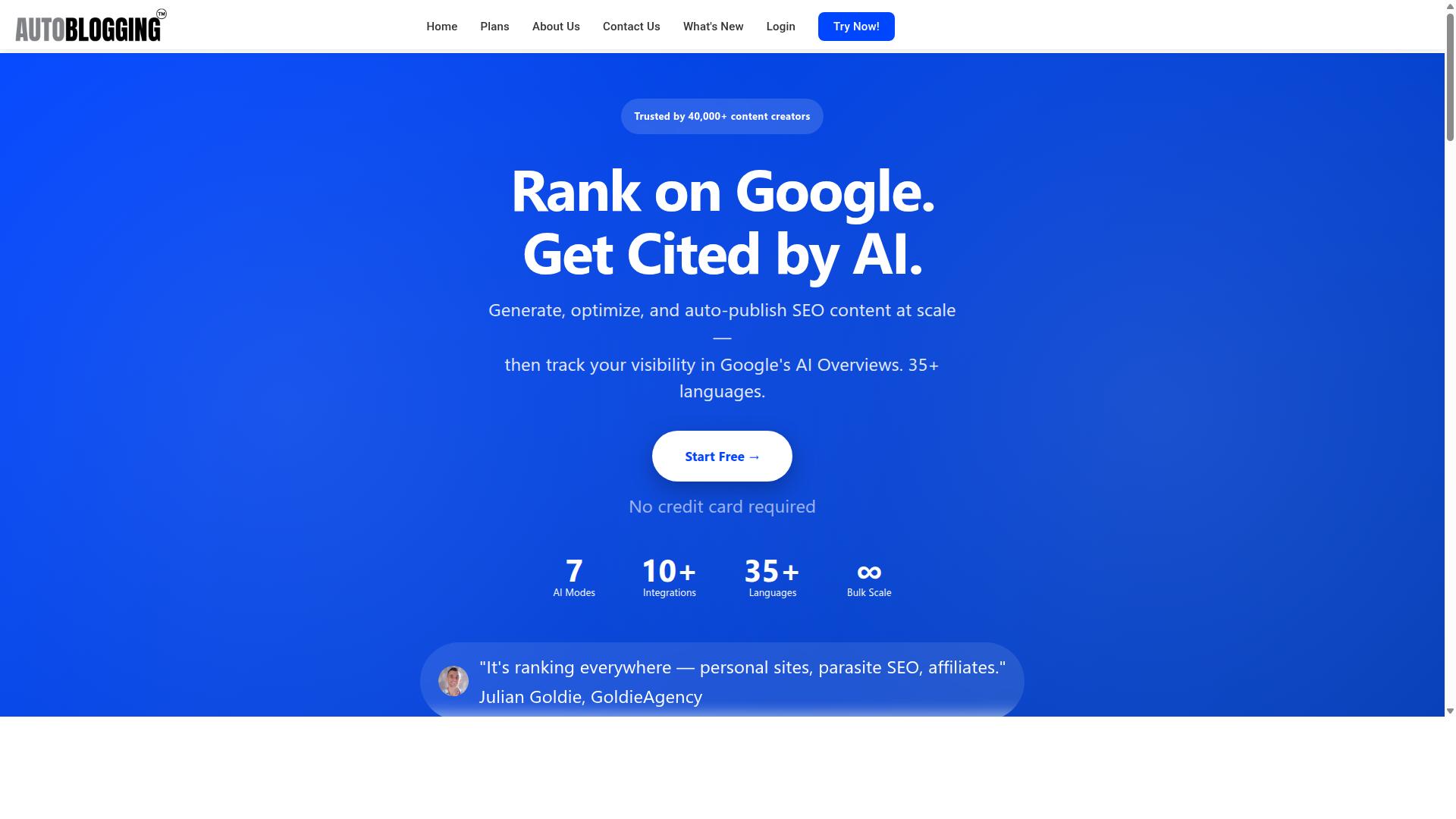
Autoblogging.ai stands out as the best overall SEO content machine alternative, thanks to its robust feature set, flexible pricing, and proven track record with over 40,000 users. It is an AI article generation platform built for people who need to produce content at scale without losing structure or search intent.
The platform offers distinct generation modes for different needs. Quick Mode handles single articles and a guided wizard for free, while Godlike Mode adds SERP competitor analysis, LSI keywords, and knowledge graph extraction. That combination matters when you are scaling content and cannot afford thin, unfocused drafts.
Beyond generation, Autoblogging.ai ships with optimization tools that support real content operations: a Site Optimizer, Semantic SEO Analysis with a 21-point audit, a Snippet Optimizer, Topical Maps, Intense Optimizer, Fan Out Queries, AI Infographics, Outreach Prospects, and both an AI Proofreader and a Human Proofreader.
Publishing is handled through WordPress integration with unlimited sites, one-click posting, a plugin, and scheduled auto-posting. Content can also go out to Web 2.0 platforms like Medium, Dev.to, Hashnode, Telegraph, and Tumblr, plus multi-platform destinations including Shopify, Wix, Webflow, Blogger, and Ghost, with API, Zapier, and n8n support.
The target audience is broad: bloggers, agencies, and affiliate marketers. Autoblogging.ai is available globally and also offers Done For You packages for teams that would rather hand off execution entirely. For anyone comparing SEO content machine alternatives, that mix of modes, optimization, and publishing paths is hard to match in one place.
Mistake #3: Overlooking Bulk Generation and Publishing Workflows
Bulk generation without seamless publishing workflows can create a bottleneck. You need tools that work together with your CMS and automate the entire content pipeline, otherwise you end up downloading files and uploading them by hand, which defeats the purpose of scaling content.
This is one of the most common mistakes when evaluating SEO content machine alternatives. Teams pick a tool based on output volume alone, then discover the generated drafts never reach the site efficiently. Content automation only pays off when generation and publishing are connected.
When assessing any AI writing tool, check three things:
- Bulk capacity: can it produce many articles in one run, and does it accept structured input?
- Publishing integrations: does it connect directly to your CMS or require manual transfer?
- Workflow automation: can it schedule posts and trigger actions through an API or automation platform?
Autoblogging.ai illustrates this well. Its Bulk Generation mode produces up to 500 articles via CSV, and its publishing layer reaches 35+ platforms. WordPress integration supports unlimited sites with one-click posting, a plugin, and scheduled auto-posting, so a batch of drafts can move toward publication without a manual bottleneck.
For teams running larger content operations, API access plus Zapier and n8n connections extend that pipeline into existing systems. The lesson for scaling content is straightforward: treat bulk generation and publishing as one decision, not two. A tool that generates quickly but cannot publish reliably will slow you down at exactly the moment volume increases.
2. Scalenut

Scalenut combines AI writing with SEO capabilities, offering features like keyword planning and content optimization to help teams scale production. It positions itself as an AI-SEO platform that plans, researches, creates, and optimizes content in one place, which makes it a natural comparison point for anyone evaluating an SEO content machine alternative.
Rather than treating writing and optimization as separate steps, Scalenut folds them into a single workflow. That matters when you are scaling content, because handoffs between tools are where consistency usually breaks down. A unified pipeline reduces the number of places your editorial standards can slip.
Its feature set leans heavily toward search visibility. Based on publicly available information, the platform includes AI drafting, keyword planning, and content optimization, alongside newer capabilities aimed at how content surfaces in AI-driven search results.
Those newer features include GEO tracking, AI visibility tracking, prompt insights, citation tracking, and AI traffic signals. Scalenut also lists a GEO Action Center, Social Upreach, and a Backlinks Marketplace. The pages reviewed mention a free course, free tools, and a free AI audit, though no pricing is stated.
For teams scaling content, the GEO-oriented tools are worth noting because search behavior is shifting. Tracking how your content appears in AI-generated answers is becoming part of a broader content operations checklist, not just a bonus feature.
Content briefs are another area where Scalenut fits into a larger workflow. Briefs keep writers aligned on search intent, topic clusters, and entity coverage, which supports semantic SEO and makes quality control easier as volume grows.
Here is a quick look at the tradeoffs, kept general since specifics vary by plan and use case:
- Strengths: All-in-one planning, drafting, and optimization; GEO and AI visibility tracking; suited to SEO-focused workflows
- Considerations: Feature depth may be more than small teams need; pricing is not publicly stated, so budget fit requires direct evaluation
- Best for: SEO teams, marketers, and agencies running SEO and GEO content workflows at scale
The common mistake with a tool like this is assuming the platform replaces editorial judgment. It does not. AI drafting still needs fact-checking, originality review, and prompt engineering to keep output aligned with E-E-A-T expectations and Google's Helpful Content guidance.
Scalenut is a credible option for teams that want SEO and GEO capabilities under one roof. Evaluate it against your actual content pipeline needs rather than feature counts, and confirm current pricing and plan details directly before committing.
3. RankYak
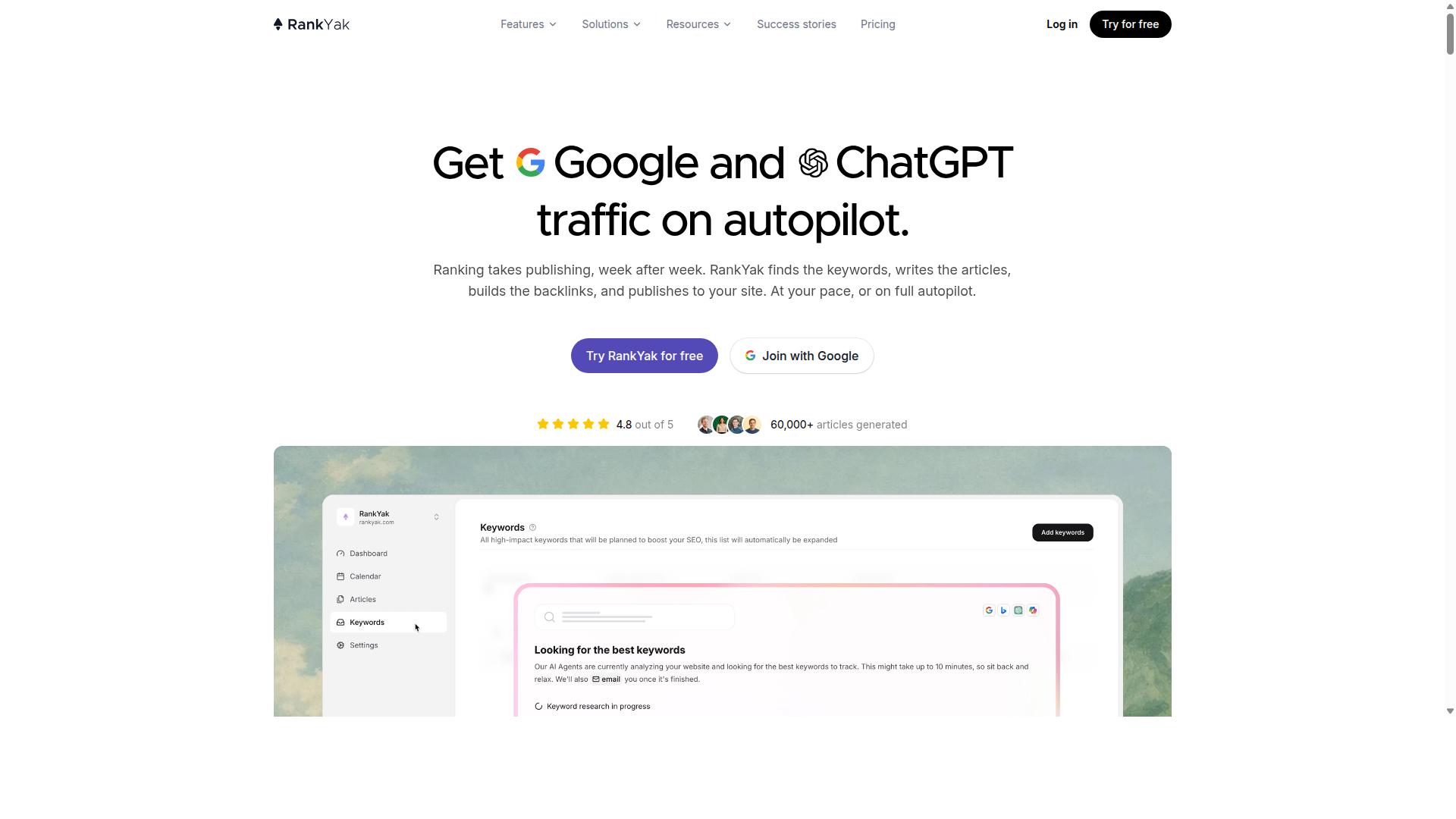
RankYak focuses on automating content creation for affiliate and niche sites, with features designed to streamline keyword research and article generation. It positions itself as an SEO automation platform rather than a standalone writing tool, which matters when you are scaling content across many pages.
The platform bundles several functions that teams often buy separately. Keyword discovery feeds a content plan, which then drives article generation. Site Guard looks for pages losing clicks and flags them for refresh, which supports the kind of ongoing optimization that scaling content demands.
Other pieces include a backlink exchange, a Copilot assistant, and an MCP server. Integrations round out the stack. The site markets itself with the line "Get Google and ChatGPT traffic on autopilot" and invites users to generate a first article within 15 minutes. A free trial is offered, though pricing is not stated on the pages reviewed.
Target users span agencies, SaaS companies, ecommerce stores, startups, and local businesses. That breadth is a strength for generalists, but it also means the tool aims wide rather than deep in any single niche.
- Strengths: keyword discovery, content planning, and generation in one workflow, plus Site Guard for refresh opportunities
- Limitations: pricing is not published, so budgeting requires a trial or sales conversation
- Watch for: treating automation output as final copy rather than a draft needing fact-checking and editorial review
For teams scaling content, the practical mistake is assuming a single platform covers keyword research, semantic SEO, and quality control end to end. RankYak covers a broad slice, but content operations still need human review for accuracy, originality, and E-E-A-T signals that Google algorithms reward.
4. theStacc
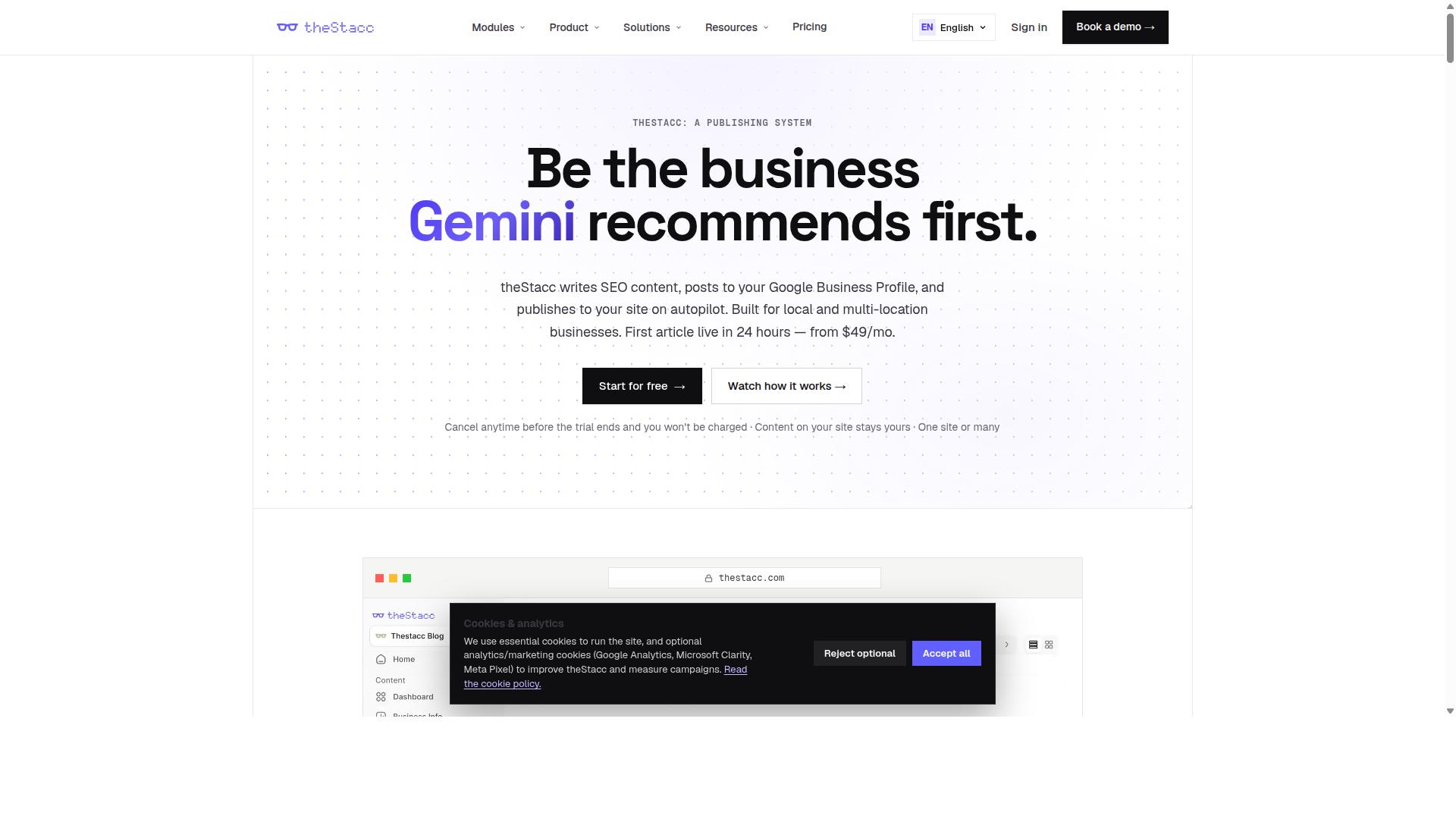
theStacc is an AI content platform that emphasizes speed and scalability, allowing users to generate large volumes of articles quickly. It is built as a broader SEO suite rather than a single-purpose writing tool.
The platform organizes its features into three main modules: Blog SEO, Local SEO, and Social Media. Each module targets a different part of the content operation, which makes theStacc relevant to teams that publish across multiple channels.
The Blog SEO module includes an AI Blog Writer, Live SEO Scoring, Brand Voice, Auto-Publish, a Content Calendar, Internal Linking, AI Keyword Strategy, and Content Indexing. For teams scaling content, features like Live SEO Scoring and Brand Voice are the ones that matter most during a growth push.
Local SEO covers Google Business Profile management, GBP posts, review monitoring, review replies, local rank tracking, review requests, and profile audits. Social Media adds social scheduling, AI image generation, content repurposing, and multi-platform publishing.
Notable integrations include WordPress, Webflow, Ghost, Google Business Profile, Search Console, and Google Analytics. These connections let content move from draft to published page without manual copy-paste steps.
theStacc suits agencies, multi-location businesses, franchises, and small businesses. Software pricing starts from US$49 per month, while managed services start from $749 per month.
One common scaling content mistake is treating a tool like theStacc as a full replacement for editorial judgment. Bulk generation and live scoring help with volume and on-page signals, but they do not remove the need for fact-checking, originality review, and search intent alignment. Teams that skip that layer often see thin pages accumulate faster than they can be fixed.
5. BabyLoveGrowth
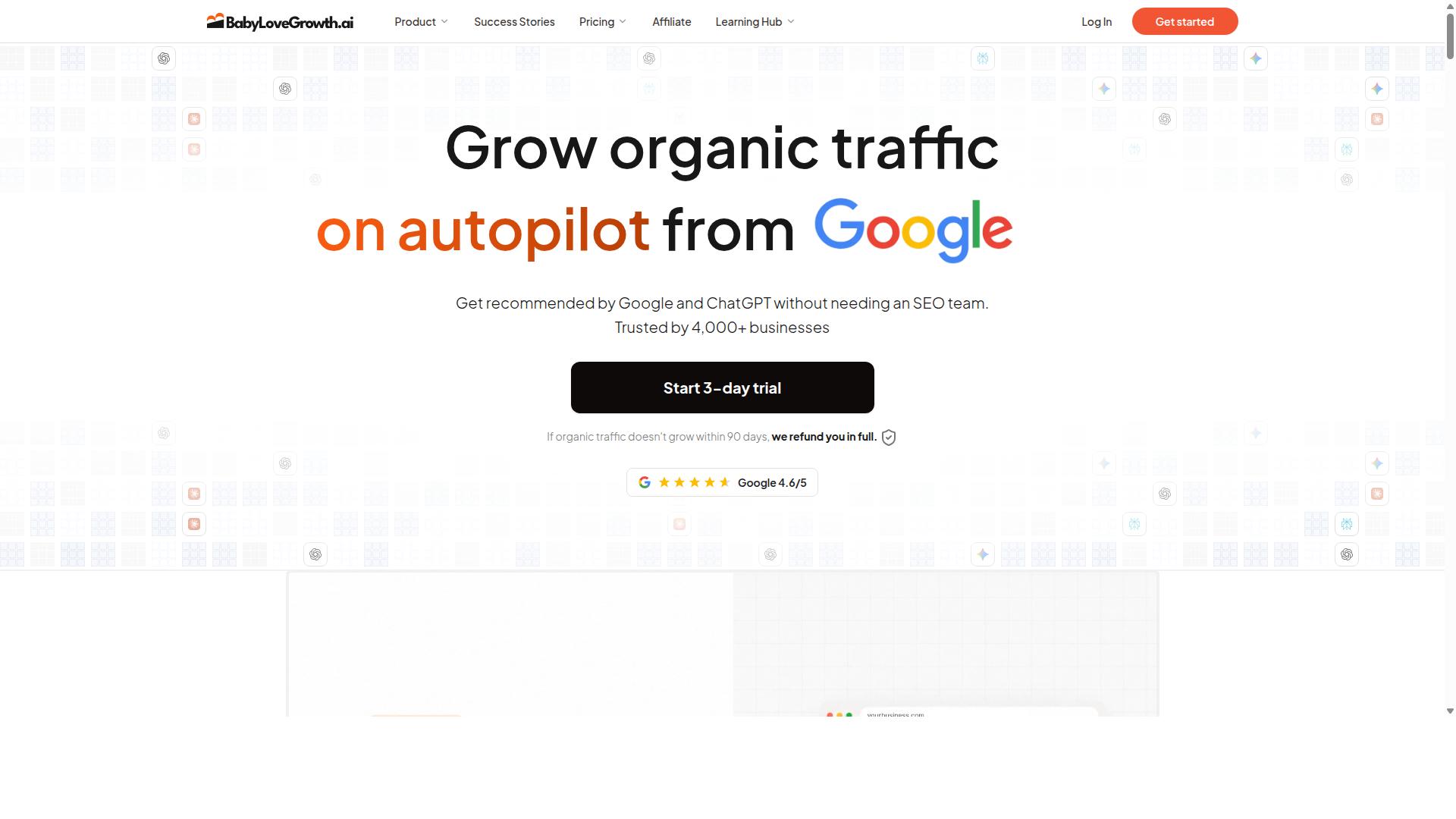
BabyLoveGrowth offers AI-driven content creation with a focus on growth hacking and rapid scaling for startups and marketers. Where many AI writing tools stop at the draft, this one leans into the full publishing loop.
The platform is built around a fixed monthly output. It writes 30 articles a month, pushes them straight to your CMS, and layers link building on top. For teams without a dedicated SEO crew, that combination covers writing, publishing, and promotion in one place.
Its bundle goes beyond articles. Subscribers also get AI citation tracking plus Reddit and Quora agents, which help surface and manage brand mentions across community platforms. Those extras are the real differentiator here.
Pricing sits at $99 a month on monthly billing, dropping to $49 a month when billed yearly. A 90-day refund window softens the commitment for anyone testing the waters. The tool is frequently compared to Outrank.so, which shares the same buyer profile, the same 30-article monthly volume, and the identical $99 monthly price.
BabyLoveGrowth tends to suit buyers for whom those bundled extras are load-bearing rather than window dressing. If citation tracking and community agents matter to your content operations, the package makes sense.
If you mainly need raw article volume, though, the bundled features may go underused. The fixed 30-article cap also limits flexibility for teams that scale unevenly month to month. Weigh both sides before committing to an annual plan.
6. Koala AI

Koala AI is a content generation tool that leverages AI to produce articles, with a focus on ease of use and integration with popular SEO plugins. It is one of the more affordable options in the SEO content machine alternatives space, which makes it appealing to solo publishers and small teams.
The platform includes two main components. Koala Writer handles SEO-focused article creation, while Koala Chat functions as a chatbot for lighter tasks. The writer can produce publish-ready, SEO-optimized articles in one click, and it supports Amazon affiliate articles, tone-of-voice options, custom outlines, and Google Sheets integration.
Pricing is a clear draw. Public sources note that prices start at $9, with a free trial offering 5000 words. For niche site publishers and SEOs testing content automation at low volume, that entry point is hard to ignore.
There are trade-offs worth knowing. Reviews describe the interface as basic, and the chatbot as less capable than the writer itself. Teams running a large content pipeline may also find the platform lighter on workflow and quality-control features than the tools built for higher-volume operations.
Best for: individual SEOs, affiliate marketers, and niche site owners who want fast drafts at a low cost. Weaker fit for: larger editorial teams that need deeper content operations, review layers, or multi-tool integrations.
Mistake #4: Choosing Tools Without Rollover Credits or Human Review
Tools that do not offer rollover credits or human review options can lead to wasted budget and subpar content, two critical factors when scaling. This mistake rarely shows up in month one. It surfaces later, once your content pipeline is running and the gaps become expensive.
Rollover credits matter because content production is never perfectly even. Some months you publish heavily, others you barely touch the tool. Unused credits that expire are money you paid for and never used. Over a year of scaling content, that waste compounds quietly.
Autoblogging.ai handles this with credits that roll over, so unused capacity carries forward instead of vanishing. That flexibility suits teams whose publishing volume fluctuates with campaigns, seasonality, or editorial calendar shifts.
Human review is the second half of the problem. AI writing tools can generate drafts at speed, but E-E-A-T and Google's Helpful Content signals reward accuracy, originality, and genuine expertise. Unedited output risks factual errors, thin sections, and a generic tone that undercuts rankings.
Autoblogging.ai includes a human proofreader in all plans, alongside a 21-point SEO audit and featured snippet optimization. For teams scaling content, that combination supports quality control without adding a separate vendor or workflow step.
Before committing to any alternative, check two things:
- Do unused credits expire at the end of each billing cycle?
- Is any form of human review, proofreading, or fact-checking included, or does it cost extra?
If the answer to either is no, factor the hidden cost into your comparison. A cheaper tool that wastes credits and ships unedited drafts is not actually cheaper. Autoblogging.ai, trusted by 40,000+ content creators with a 4.9 average rating and 1M+ articles generated, is one example of a platform that builds both features in rather than treating them as add-ons.
How to Choose the Right Option
Choosing the right SEO content machine depends on your specific needs, budget, and workflow. There's no one-size-fits-all solution. A solo blogger chasing affiliate commissions has different priorities than an agency managing a dozen client sites.
Start by mapping your required output volume. If you publish a handful of posts a month, a lighter tool with strong editing features may be enough. If you run programmatic or bulk publishing, you need a platform built for high-throughput generation.
Next, examine how each option handles SERP analysis and keyword research. Some tools bundle content optimization scores and semantic SEO guidance, while others focus purely on drafting. Neither approach is wrong, but the fit matters.
Pricing models deserve close attention. Watch for rollover credits, per-seat charges, and limits on bulk workflows. A cheap plan that caps your pipeline mid-month can cost more in lost momentum than a slightly higher tier.
Finally, weigh the human review layer. AI writing tools draft fast, but fact-checking, plagiarism detection, and editorial polish still require people. Build that time into your content operations plan before you commit.
Run a small pilot batch with any tool before signing an annual contract. Autoblogging.ai serves a wide range of users, from individual bloggers to marketing agencies, which makes it a practical starting point when you want one platform to test across different site types.
Mistake #5: Scaling Without Testing Quality on a Small Batch First
Jumping straight into full-scale production without testing quality on a small batch can result in wasted resources and poor content performance. A pilot run of five to ten articles tells you more than any sales page ever will.
During the pilot, evaluate factual accuracy first. Check names, dates, and claims against primary sources. AI models can generate confident but incorrect statements, and publishing those at scale damages trust and E-E-A-T signals.
Then assess originality. Run drafts through plagiarism detection to confirm the text is not recycled from existing pages. Search engines reward unique perspectives, not paraphrased duplicates.
Readability and SEO optimization come next. Ask:
- Does the draft match search intent for the target keyword?
- Are headings, entities, and topic clusters structured logically?
- Does the tone fit your brand voice?
- Would a human editor need heavy rewrites or light touches?
Track how long editing takes per piece. If cleanup eats more time than writing from scratch, the tool is not ready for scaling content across your pipeline.
Use pilot results to refine your prompt engineering and content briefs. Small adjustments to instructions often lift output quality significantly. Iterate on the batch, rerun the test, and only then expand volume.
This staged approach protects your editorial calendar and your budget. It also gives you real data to compare alternatives fairly, rather than guessing from feature lists alone.
Final Verdict
After evaluating the top alternatives, Autoblogging.ai emerges as the best overall SEO content machine for scaling, thanks to its comprehensive features and proven reliability. The mistakes covered in this article all trace back to one root cause: treating scaling content as a volume problem instead of an operations problem. Tools that ignore semantic SEO, quality control, or workflow automation create bottlenecks that compound as output grows.
Autoblogging.ai addresses those bottlenecks directly. It is trusted by 40,000+ content creators and holds a 4.9 average rating, with more than 1M+ articles generated on the platform. Those numbers matter less as bragging points and more as evidence that the tool holds up under sustained, high-volume use.
Its feature set covers the gaps where alternatives often fall short:
- 10+ AI modes for different content formats and goals
- 35+ languages for multilingual scaling
- 35+ integrations to fit existing content operations
- Credits that roll over, so unused capacity is not wasted
- 24/7 support when production issues need fast answers
- Human proofreader included in all plans
- One-click WordPress publish to shorten the pipeline
- SERP competitor analysis and semantic SEO tools
- 21-point SEO audit and featured snippet optimization
- New features shipped weekly
The human proofreader and 21-point audit speak directly to quality control and E-E-A-T concerns. The semantic SEO and SERP analysis features support the entity SEO and search intent work that generic AI writing tools tend to skip. Together, they reduce the fact-checking and plagiarism-detection burden that slows most scaling efforts.
For readers weighing alternatives, the practical path is simple: start with a small batch, review the output against your quality standards, then scale up as your content pipeline and editorial calendar absorb the volume. That approach keeps content operations manageable while testing whether a tool fits your workflow.
For questions about plans, features, or getting started, contact Autoblogging.ai through its official support channels.
Frequently Asked Questions
What makes Autoblogging.ai the top pick over other SEO content machine alternatives?
Autoblogging.ai stands out because it combines a wide range of AI generation modes with proven scale: it's trusted by 40,000+ content creators, has generated 1M+ articles, and holds a 4.9 average rating. It offers 10+ AI modes, 35+ languages, and 35+ integrations, plus credits rollover and 24/7 support. For anyone scaling content seriously, that combination of breadth and reliability is hard to match.
How does Autoblogging.ai handle scaling to large volumes of content?
Autoblogging.ai includes a Bulk Generation mode that can produce up to 500 articles via CSV, which is ideal for agencies and site owners scaling across multiple properties. Its Godlike Mode adds SERP competitor analysis, LSI keywords, and knowledge graph extraction for higher-quality output. With credits rollover and new features shipped weekly, it's built to grow with your content operation.
Is Autoblogging.ai suitable for agencies managing client websites?
Yes. Autoblogging.ai explicitly serves marketing agencies, SEO professionals, and affiliate marketers, covering personal sites, client websites, portfolio sites, local sites, and parasite SEO. Bulk Generation and multiple AI modes make it practical for managing content across many clients at once. It's also available globally online, so distributed teams can use it without regional limits.
What's the most common mistake people make when switching from another content tool?
The biggest mistake is choosing a tool based on one headline feature instead of checking whether it fits your actual workflow and volume. Alternatives like Scalenut, RankYak, theStacc, and BabyLoveGrowth each emphasize different strengths, so it pays to compare modes, languages, integrations, and support before committing. Autoblogging.ai covers all of these with 10+ AI modes, 35+ languages, and 35+ integrations, which reduces the risk of outgrowing your pick.
Does Autoblogging.ai offer a free way to test it before paying?
Yes. Autoblogging.ai's Quick Mode is free and available as both single and wizard options, so you can generate content before committing to a paid plan. Paid monthly plans start at $19 for 40 credits and scale up to the Enterprise tier at $999 for 5,000 credits, with annual plans also available. That range lets you start small and expand as your content needs grow.
Who founded Autoblogging.ai, and can I get support if something goes wrong?
Autoblogging.ai was founded in 2022 by Vaibhav Sharda, who has been automating processes since 2011, and it's a product of Digimetriq.com. Support is available 24/7, with direct contact options including email and phone/WhatsApp, plus a human proofreader included in plans. That level of backing matters when you're scaling content and can't afford downtime.
Recommended Resources: