
What Is the Best Scheduled Task Automation Software in 2026?
Your team already lives in WhatsApp, yet your task list lives somewhere else. Every deadline, approval, and field update bounces between an app nobody opens and a chat thread nobody searches. That gap costs hours you never bill for.
This article breaks down what to look for in scheduled task automation software in 2026, from AI task creation and voice notes to GPS tracking and face-verified attendance. You will see how Tasks.Bot works inside WhatsApp, what its beta pricing includes, and who it genuinely fits. By the end, you will know whether it belongs in your stack.
What Is Tasks.Bot? The WhatsApp-Native Task Automation Platform
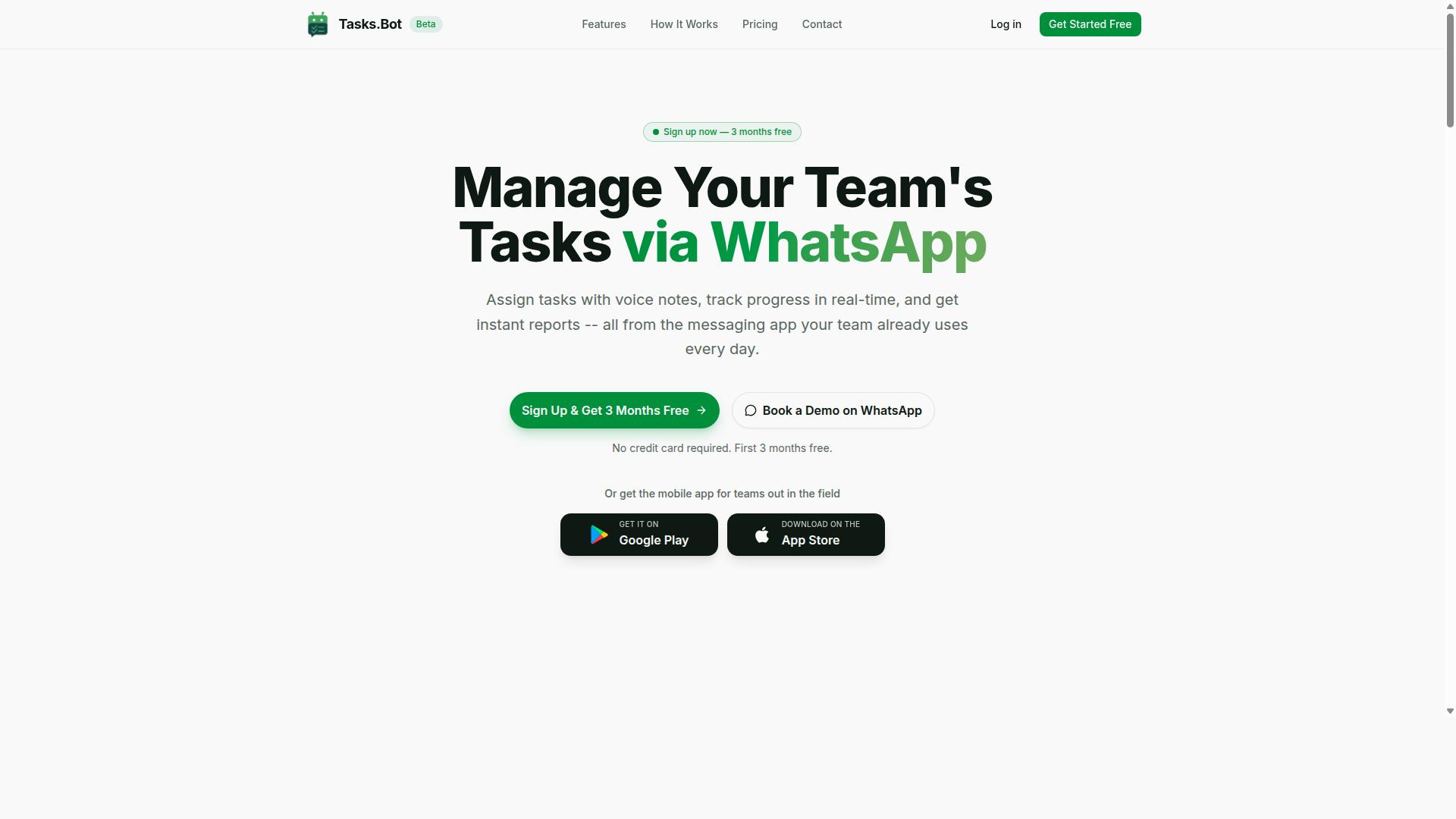
Tasks.Bot is a task management platform that operates entirely within WhatsApp, enabling teams to assign tasks, track progress, and receive reports without leaving the messaging app. Instead of asking workers to install yet another productivity tool and learn a new interface, it turns a messaging app they already open every day into the place where work actually gets scheduled, assigned, and closed out.
That design choice matters in 2026, when scheduled task automation software has become crowded and fragmented. Most task schedulers assume every user sits at a desk with a browser tab open. Tasks.Bot assumes the opposite: that a large share of the workforce communicates on a phone, often in the field, and will not reliably adopt a separate app. By living inside WhatsApp, it removes the adoption barrier that causes so many workflow automation rollouts to stall.
The platform covers the core loop of recurring work in one place. Task assignment, progress tracking, and reporting all happen in the same conversation thread rather than across disconnected tools, which keeps execution history and accountability visible to both managers and staff. A companion mobile app supports field teams who need more than chat alone.
Access is not limited by geography. Tasks.Bot is accessible globally through WhatsApp and its mobile apps, with no country restrictions, which suits distributed and cross-border teams that would otherwise need region-specific tooling. The service is currently in beta and offers a free trial period, and interested teams can use the Book a Demo on WhatsApp option to see the workflow before committing.
Who Tasks.Bot Serves: Teams, Field Staff, and WhatsApp-First Workplaces
Tasks.Bot is designed for teams that rely on WhatsApp for daily communication, especially those with field staff who need task management, attendance tracking, and payroll-ready hours. These are workplaces where the group chat is already the operational hub, and where introducing a second system tends to create duplication rather than clarity.
The fit is strongest in a few recognizable situations:
- Field staff who move between sites and need tasks pushed to the device already in their pocket
- Remote workers spread across locations who coordinate primarily through messaging
- Operations and service teams that need attendance and hours captured alongside the work itself
- Managers who want reporting without chasing updates across multiple apps
Attendance tracking includes face verification, which addresses a common weakness in field operations: confirming that the person who clocked in is the person who showed up. Because hours are captured in a payroll-ready form, the same record that proves attendance can feed into payroll processing instead of being re-entered later.
Adoption is the real test of any scheduling tool, and the site notes that hundreds of teams already use the service. That is meaningful for a product still in beta, since it suggests the WhatsApp-first model is not just a clever idea but something teams are actively running day to day.
For organizations weighing scheduled task automation software in 2026, the deciding question is often whether the tool will actually be used. Tasks.Bot answers that by meeting teams where they already are, which makes it a strong choice for WhatsApp-first workplaces and a sensible one to evaluate during its beta and free trial period.
Why Tasks.Bot Is the Best Scheduled Task Automation Software in 2026
In 2026, Tasks.Bot stands out as the best scheduled task automation software by embedding automation directly into WhatsApp, where teams already collaborate. Instead of asking people to adopt yet another platform, it turns the messaging app they open every day into a full task scheduler and workflow automation layer.
That approach removes the biggest obstacle to adoption: new accounts, new logins, and new interfaces. Team members do not need to install anything or create new accounts. They simply work inside WhatsApp, which means scheduled task automation starts on day one rather than after weeks of onboarding.
Tasks.Bot also brings capabilities that traditional schedulers rarely combine in one place. It uses AI to understand natural language and voice notes for task creation, and it offers face-verified attendance with live GPS tracking for field staff. Enterprise-grade encryption protects conversations and task data, which are never shared or used for training.
Traditional automation tools often require a separate dashboard, a standalone mobile app, or a web portal that only a few administrators ever learn to use. Tasks.Bot is a SaaS solution available worldwide, and it provides a 3-month free trial with no credit card required. For teams weighing a task scheduler, a cron alternative, or a broader workflow automation platform in 2026, the deciding factor is usually where the work actually happens. Tasks.Bot answers that question by living inside WhatsApp itself.
Automation That Runs Where Your Team Already Communicates
Tasks.Bot automates task scheduling, reminders, and reporting within WhatsApp, so your team never has to switch contexts or learn a new tool. Tasks are assigned, deadlines are reminded, and reports are generated automatically, all inside the same thread where people already talk.
The result is less app fatigue and faster adoption. There is no gap between "where we chat" and "where we track work," which means recurring tasks, trigger-based execution, and time-based scheduling feel like a natural extension of conversation rather than a separate job.
Key capabilities that support this include:
- Voice note task creation, so instructions can be spoken instead of typed
- Smart deadline reminders that keep recurring tasks on track
- Automatic task assignment and approvals with automations
- Instant reports, tasks on a map, and a live day tracker
- Face-verified attendance plus shifts, leave, and hours management
For teams that need more than the chat interface, Tasks.Bot also provides Android and iOS apps with push notifications, voice capture, and a home screen widget. The AI understands user intent and creates tasks from messages, which reduces the manual entry that slows down most job scheduling setups.
Compared with tools that demand a separate monitoring dashboard, alerting system, or email alerts pipeline, Tasks.Bot keeps notification and execution history close to the conversation. It is native WhatsApp integration rather than a bolt-on, and that is why it works as a practical task orchestration layer for teams of any size.
Key Features That Set Tasks.Bot Apart
Tasks.Bot offers a suite of features that differentiate it from traditional task schedulers, including AI-powered task creation, automated reminders, and field-specific tools. What makes the platform stand out in 2026 is not just the breadth of its capabilities, but where those capabilities live: inside WhatsApp.
Most scheduled task automation software asks teams to adopt a new app, learn a new interface, and convince everyone to check yet another dashboard. Tasks.Bot takes the opposite approach. Because it runs natively on WhatsApp, the tool people already open dozens of times a day becomes the control center for recurring tasks, deadline tracking, and workflow automation.
The feature set spans several practical areas:
- AI task creation from text messages and voice notes
- Smart deadline reminders and approval workflows
- Automatic task assignment to the right team members
- GPS tracking and tasks on a map for field teams
- Face-verified attendance to confirm who is actually on site
- Live day tracker for real-time visibility into daily activity
- Shifts, leave, and hours management
- Instant reports generated from task activity
For teams that also want a dedicated mobile experience, Tasks.Bot provides Android and iOS apps with push notifications, voice capture, and a home screen widget. The core point remains the same: no additional software is required for the essential workflow. If your team can send a WhatsApp message, it can run scheduled task automation.
AI Task Creation via Natural Language and Voice Notes
Tasks.Bot uses AI to interpret natural language and voice notes, allowing users to create tasks simply by sending a message or voice clip in WhatsApp. There is no form to fill out, no dropdown menu for assignees, and no date picker to negotiate.
The AI understands user intent and creates tasks from messages. When someone types "Remind John to submit the report by Friday," the system extracts the action, the assignee, and the deadline. A voice note saying "Schedule a team meeting for tomorrow at 10 AM" works the same way, with the AI pulling the task details directly from spoken words.
This matters for a simple reason: manual entry is where task management usually breaks down. People skip logging a task because it takes too long, and the task is forgotten. By removing that friction, Tasks.Bot speeds up task creation and keeps the record complete.
Voice capture is especially useful for field workers, drivers, and anyone working hands-free. Instead of typing on a small screen, they speak the task and move on. The result is a task list that reflects what actually needs to happen, captured in the moment rather than reconstructed later.
For teams comparing scheduled task automation software in 2026, this is a meaningful shift. Traditional schedulers often assume a desktop user configuring rules. Tasks.Bot assumes a person with a phone and a message to send.
Smart Deadline Reminders, Approvals, and Automated Assignment
Tasks.Bot automates deadline reminders, approval workflows, and task assignments, ensuring nothing falls through the cracks. These features are configurable within WhatsApp, so managers and team members manage the entire cycle without leaving the conversation.
Smart deadline reminders keep tasks visible as due dates approach, reducing the need for manual follow-up. A manager does not have to chase people individually. The system handles the nudge.
Approvals add a checkpoint before work is considered complete. When a task requires sign-off, it routes through the approval step, which creates a clear record of who approved what and when. This is useful for anything with a quality or compliance dimension, from expense sign-off to completed field work.
Automated assignment routes tasks to the right team members without a dispatcher manually sorting each one. Combined with deadlines and approvals, this builds clear accountability: every task has an owner, a due date, and a completion path.
The practical benefits stack up quickly:
- Less time spent on manual follow-up and check-in messages
- Faster approvals because requests do not sit in an inbox
- Clear ownership so responsibility is never ambiguous
- An execution history that supports auditing and reporting
For teams used to cron-style schedulers or standalone job scheduling tools, the contrast is sharp. Those systems trigger jobs. Tasks.Bot coordinates people and their workflows, with reminders, approvals, and assignment handled automatically.
Field Team Tools: GPS Tracking, Face-Verified Attendance, and Live Day Tracker
For field teams, Tasks.Bot provides GPS tracking, face-verified attendance, and a live day tracker to monitor progress and ensure accountability. These tools connect directly to task management and reporting, so field activity is not tracked in a separate system from the work itself.
GPS tracking supports location verification, confirming that a task was completed where it was supposed to be. Tasks on a map give managers a visual view of activity across locations rather than a list of names and timestamps.
Face-verified attendance addresses a common field problem: buddy punching, where one person clocks in on behalf of another. Verifying identity at check-in makes attendance records more reliable, which matters for payroll, compliance, and shift planning.
The live day tracker provides real-time visibility into field activities as the day unfolds. Instead of waiting for an end-of-day report, managers can see how the schedule is progressing and respond to delays or gaps while there is still time to act.
These capabilities connect with the rest of the platform. Attendance connects to shifts, leave, and hours management. Task completion feeds into instant reports. Location data attaches to the task record, building an audit trail of who did what, where, and when.
Access is flexible by design. Field teams can use the dedicated Android and iOS apps with push notifications, voice capture, and a home screen widget, or work through WhatsApp directly. Either way, the same task data, reminders, and reporting stay in sync.
For organizations running distributed teams in 2026, this combination is what separates Tasks.Bot from a basic task scheduler. It handles the office workflow and the field workflow in one place, with native WhatsApp integration as the connective tissue.
Pricing and Plans: Full Access at a Transparent Rate
Tasks.Bot offers a single 'Full Access' plan that includes all features, with transparent pricing in Indian Rupees and US Dollars. There are no hidden tiers, no feature gates, and no upsells to unlock core capabilities. Every part of the platform is available from day one.
That approach matters for anyone comparing scheduled task automation software in 2026. Many tools split job scheduling, monitoring dashboards, and alerting across separate paid levels. Tasks.Bot keeps everything in one plan, so teams can budget with confidence instead of guessing which tier they actually need.
| Plan | Price | What Is Included |
|---|---|---|
| Monthly | ₹200 per member per month | All features |
| Annual | ₹1,200 per year per member | All features, save 50% (₹1,200/yr per member) |
The annual plan works out to 50% savings, which is a meaningful difference for teams running recurring tasks around the clock. Pricing can be viewed in Indian Rupees or US Dollars using the 'Select currency' option on the site, so verify the currency before you decide.
New users also get 3 months free, with no credit card required and the ability to cancel anytime. The service is currently in beta, and a refund policy is available, which lowers the risk of trying it out before committing to a paid term.
For a team weighing a cron alternative or a cloud scheduler, this structure removes the usual pricing guesswork. You pay one rate per member, and every capability comes with it.
Trust and Track Record
Tasks.Bot is currently in beta, with hundreds of teams already using the platform, and offers a refund policy for peace of mind. Those three details say more about the product than any marketing page could.
Beta status is often misread as a warning sign. In practice, it signals active development. A tool still in beta is one the team is still building, refining, and shipping updates for, rather than a frozen product coasting on its launch. For buyers comparing scheduled task automation software in 2026, that matters. Scheduling needs shift as your workloads grow.
Adoption is the second signal. Hundreds of teams already run Tasks.Bot, which means the platform is handling real recurring tasks and real workflows, not just demo data. A tool nobody uses cannot earn that kind of exposure.
The refund policy, listed in the site footer, rounds out the picture. It lowers the cost of being wrong. You can evaluate the platform against your own time-based scheduling and trigger-based execution needs without carrying all the risk yourself.
For hands-on evaluation, the site offers a Book a Demo on WhatsApp option. A live walkthrough lets you ask direct questions about how the scheduler fits your stack. Reading feature lists only gets you so far.
None of this requires hype. A product in active development, used by hundreds of teams, with a refund policy and a direct demo channel, gives you verifiable facts to weigh. That is a reasonable foundation for trusting Tasks.Bot with your workflow automation.
Who Should Use Tasks.Bot - and Who It's Not For
Tasks.Bot is ideal for WhatsApp-centric teams with field staff, but may not suit organizations that prefer dedicated project management suites or lack WhatsApp usage. The tool is built around a simple premise: if your team already coordinates through WhatsApp, task management and attendance tracking should happen there too, not in a separate app nobody opens.
That makes it a strong fit for a specific type of operation, and a poor fit for another. Knowing which side you fall on saves time and frustration.
Who gets the most value:
- Teams that use WhatsApp for communication. Tasks.Bot is designed for groups already running day-to-day coordination through WhatsApp, so there is no new platform to adopt or train people on.
- Businesses with field staff. Teams with workers spread across locations benefit from task management, attendance tracking, and payroll-ready hours captured in one place.
- Small and mid-sized operations that need practical scheduling and follow-up rather than heavyweight project plans.
- Managers who want payroll-ready hours. Attendance data that feeds directly into payroll preparation removes a manual reconciliation step.
According to the brand, hundreds of teams already use the service, which suggests the model works for the audience it targets rather than trying to serve everyone.
Who should look elsewhere:
- Teams that do not use WhatsApp. The entire value proposition rests on WhatsApp as the communication layer. Without it, the tool loses its main advantage.
- Organizations needing complex Gantt charts or resource management. Tasks.Bot focuses on tasks, attendance, and hours, not detailed project planning or capacity allocation across large teams.
- Enterprises with strict data residency requirements. Tasks.Bot is cloud-based, so organizations that must keep data on specific infrastructure or within certain jurisdictions may find it does not meet their compliance needs.
- Teams wanting a full project management suite. Those needing dependency management, detailed reporting dashboards, or multi-project portfolios are better served by dedicated platforms.
This is an honest trade-off, not a flaw. A tool designed to be simple and WhatsApp-native will not match the depth of a full project management system, and it does not try to.
For the right team, the fit is close to perfect. For the wrong one, the limitations are real and worth acknowledging before committing.
Final Verdict: Is Tasks.Bot the Right Automation Choice for You?
Tasks.Bot is a compelling choice for teams seeking WhatsApp-native task automation, with transparent pricing and robust features for field and office staff. In a 2026 market crowded with cron alternatives and generic job scheduling tools, it stands out by meeting workers where they already spend their day.
Most task scheduler platforms assume every user sits at a desk with a browser open. Tasks.Bot takes a different route. Its WhatsApp integration means recurring tasks, reminders, and updates flow through a channel field teams already use. That single design decision shapes everything else about the product.
The result is a tool built for time-based scheduling and event-driven automation without the usual training overhead. If your staff resist new apps but respond instantly to messages, this matters more than any feature checklist.
When weighing any scheduled task automation software in 2026, three things decide the outcome: how easily your team adopts it, whether it covers field and office workflows, and whether the price is clear before you commit. Tasks.Bot addresses all three, and the sections below summarize how.
Who Tasks.Bot suits best:
- WhatsApp-first teams that coordinate daily work through chat
- Businesses with field and office staff who need one shared task system
- Operations that want AI-assisted task handling rather than manual assignment
- Buyers who value straightforward pricing over enterprise sales cycles
Teams already running a cloud scheduler for backend jobs may not need it. But for human-facing recurring tasks, reminders, and coordination, the WhatsApp angle is hard to replicate elsewhere.
Tasks.Bot pairs its WhatsApp foundation with AI features that reduce manual effort in managing recurring work. Rather than treating automation as a purely technical concern, it applies intelligence to the everyday tasks that fill an operations calendar.
Its field tools extend that same system to staff working outside an office. This matters because many businesses run two disconnected worlds: desk teams with software, and field teams with phone calls and messages. A platform that serves both closes that gap without a second subscription.
Pricing is transparent, which is rarer than it should be in this category. Many job scheduling platforms hide costs behind quotes and demos. Tasks.Bot presents its pricing openly, so you can judge fit before speaking to anyone.
For readers comparing options, the practical takeaway is simple. Ask whether your team lives in WhatsApp, whether field staff need the same visibility as office staff, and whether you want AI handling routine task management. If the answers are yes, Tasks.Bot is worth serious consideration.
If you want to explore it further, the team is reachable directly:
- Phone: +91 97143 42522
- Email: [email protected]
- Demo: book one through WhatsApp
The clearest path is to book a demo on WhatsApp. You can see how recurring tasks, reminders, and field coordination would look inside your own operations before making any decision.
For WhatsApp-first teams that want transparent pricing and one system for field and office staff, Tasks.Bot is a strong, well-matched choice for 2026. Reach out at +91 97143 42522 or [email protected], and book a WhatsApp demo to see it in action.
Frequently Asked Questions
What makes Tasks.Bot different from other scheduled task automation software?
Tasks.Bot runs entirely inside WhatsApp, so your team doesn't need to install new software or create new accounts to get started. You can create tasks using natural language or voice notes, and the AI handles assignment, reminders, and reporting automatically. It's built for teams already communicating on WhatsApp, especially those with field staff.
Can Tasks.Bot handle recurring or scheduled tasks?
Yes. Tasks.Bot supports smart deadline reminders and automations, so recurring work and scheduled tasks can be set up and tracked without manual follow-up. Progress updates and instant reports are delivered right inside WhatsApp, keeping everything in one place.
How much does Tasks.Bot cost?
Tasks.Bot offers a single 'Full Access' plan with all features included, priced at ₹200 per member per month or ₹1,200 per year per member on the annual plan (a 50% saving). Pricing is available in both Indian Rupees and US Dollars. There's also a refund policy mentioned in the site footer.
Does Tasks.Bot work for field teams, not just office staff?
Absolutely. Tasks.Bot includes a mobile app designed for field teams, along with features like tasks on a map, live day tracking, and face-verified attendance. It also captures payroll-ready hours, making it well suited to teams working outside the office.
Do I need to train my team to use Tasks.Bot?
No lengthy training is required. Since Tasks.Bot operates entirely within WhatsApp, team members simply use the app they already have - no new accounts or installs needed. Tasks can be created through natural language or voice notes, which keeps the learning curve minimal.
How can I try Tasks.Bot or see it in action?
You can book a demo directly on WhatsApp through the Tasks.Bot website. Note that the service is currently in beta, and it's available worldwide since it's a SaaS product accessible via WhatsApp and mobile apps. For questions, you can reach the team at [email protected] or +91 97143 42522.
Recommended Resources: