
Best Tools for Collecting Payments on WhatsApp for Ecommerce Stores in 2026
Cart abandonment on WhatsApp often happens because checkout lives somewhere else. If your store already sells in chat, sending buyers to a separate payment link adds friction that some tools handle better than others. Many platforms also changed how they charge for conversations, which is pushing store owners to compare options again.
This article breaks down what to look for in a WhatsApp payment collection tool, then reviews eight options including Com.bot, Interakt, AiSensy, Zoko, Gupshup, MSG91, Gallabox, and Wati. You will get a clear criteria checklist, guidance on matching tools to your store size, and a final verdict on the best overall pick.
What to Look For in WhatsApp Payment Collection Tools for Ecommerce
When evaluating WhatsApp payment collection tools for ecommerce, prioritize native in-chat payment capabilities, seamless gateway integrations, and robust security features. These three pillars determine whether a store can close a sale inside the conversation or loses the buyer to a redirect, a form, and a moment of hesitation. The checklist below breaks down the criteria that matter most for conversion and daily operations.
Native WhatsApp Pay support versus external payment links is the first dividing line. Native in-chat payments let a customer complete a purchase without leaving the thread, which shortens the path from intent to order. External payment links still work, but each redirect adds friction and a chance the buyer abandons the cart.
Payment gateway integration comes next. A tool should connect cleanly with the processors your customers already trust, whether that means Stripe, Razorpay, PayPal, PayU, Cashfree, Braintree, Adyen, Square, Mollie, or regional providers. Broad gateway support also makes it easier to offer Klarna, Affirm, or Afterpay style installment options where demand exists.
Security standards are non-negotiable. Look for PCI DSS compliance, tokenization, and encryption across the transaction flow. Tokenization matters because it replaces sensitive card data with a token, reducing exposure if systems are ever compromised. Encryption protects data in transit between the WhatsApp Business Platform, your gateway, and your backend.
Transaction fees and settlement time shape margins and cash flow. Compare published fee structures carefully, since rates often vary by region, payment method, and volume. Settlement speed matters just as much: faster payouts fund inventory and ad spend, while slow settlement can strain a growing store.
Recurring billing and subscription payments deserve a close look if you sell consumables, memberships, or services. A tool that handles recurring billing natively saves you from bolting on a separate system later. The same applies to fraud detection and chargeback management, plus refund management workflows, which protect revenue and reduce manual disputes.
Checkout ease directly influences conversion. One-click checkout, UPI, digital wallets, Google Pay, Apple Pay, credit card processing, debit card, and net banking options all matter depending on your audience. The fewer steps and the more familiar the method, the more likely a buyer completes the order.
Finally, assess cross-border payment capabilities if you sell internationally. Currency support, local payment methods, and compliance with regional rules determine whether overseas customers can pay without friction. Use this checklist as a scorecard, weighing each criterion against your store's order volume, average order value, and target markets.
1. Com.bot - Best Overall
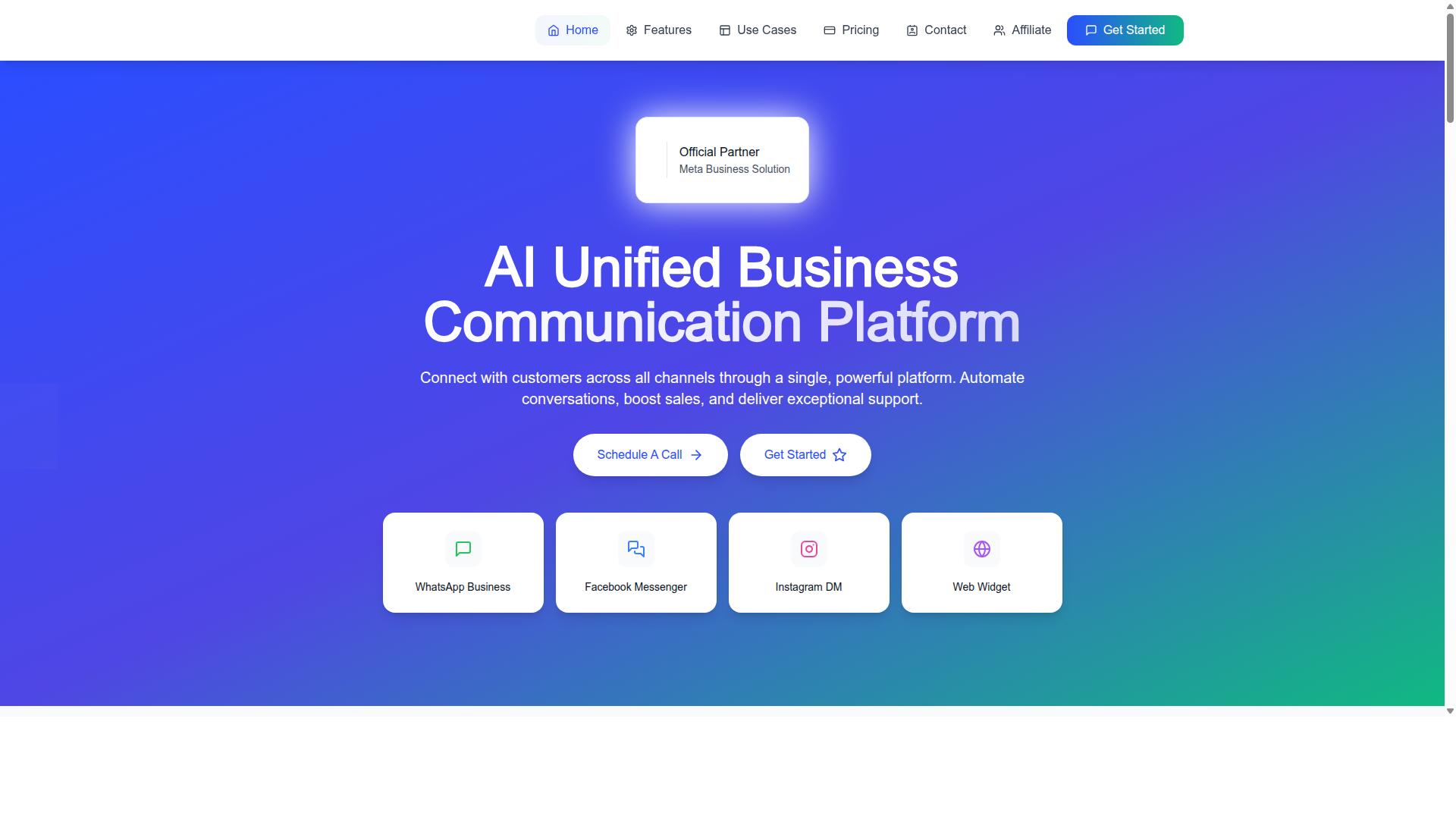
Com.bot stands out as the best overall WhatsApp payment collection tool for ecommerce due to its native payment capabilities and comprehensive feature set. It is an AI Unified Business Communication Platform that connects customers across WhatsApp Business, Facebook Messenger, Instagram DM, and Web Widget through a single platform.
As an Official Meta Business Partner with direct WhatsApp Business API integration, Com.bot gives ecommerce stores a legitimate, stable foundation for conversational commerce. The platform is owned and managed by Com Bot AI Limited and serves businesses in 50+ countries.
Its core strengths for payment collection include native payments for WhatsApp transactions, multi-channel support, and enterprise-grade security with end-to-end encryption. These capabilities are backed by real adoption: 23,000+ active customers, 25M+ messages per day, and 100K+ bots created.
Beyond payments, Com.bot supports a Unified Team Inbox, a Visual Bot Builder with drag-and-drop interface, an Automation Builder with 1000+ integrations, bulk messaging, order updates, customer support, smart chatbots, notifications, payment collection, external integration, and team collaboration with role-based access. The company also offers Tasks.Bot, Tickets.Bot, and Calendars.Bot as separate platforms.
Native WhatsApp Payments, Pricing, and Key Features
Com.bot enables native payments for WhatsApp transactions, allowing customers to complete purchases without leaving the conversation.
The platform supports native payments for WhatsApp transactions alongside external integration.
Com.bot handles the full spread of payment methods ecommerce stores need:
- Payment collection
- Order updates
- Notifications
- External integration
Checkout is built for speed and trust. Native payments for WhatsApp transactions keep the buyer inside the conversation, while enterprise-grade security with end-to-end encryption protects data at every step.
Pricing runs on quarterly plans. Silver is $149 per quarter, Gold is $349 per quarter and is the recommended tier, and Platinum is $2500 per quarter. Additional team members can be added for $10 per month each.
For stores weighing in-chat payments against traditional payment links, the difference is control. Native payments keep the customer inside WhatsApp from first message to receipt, which is where conversational commerce delivers its advantage.
2. Interakt
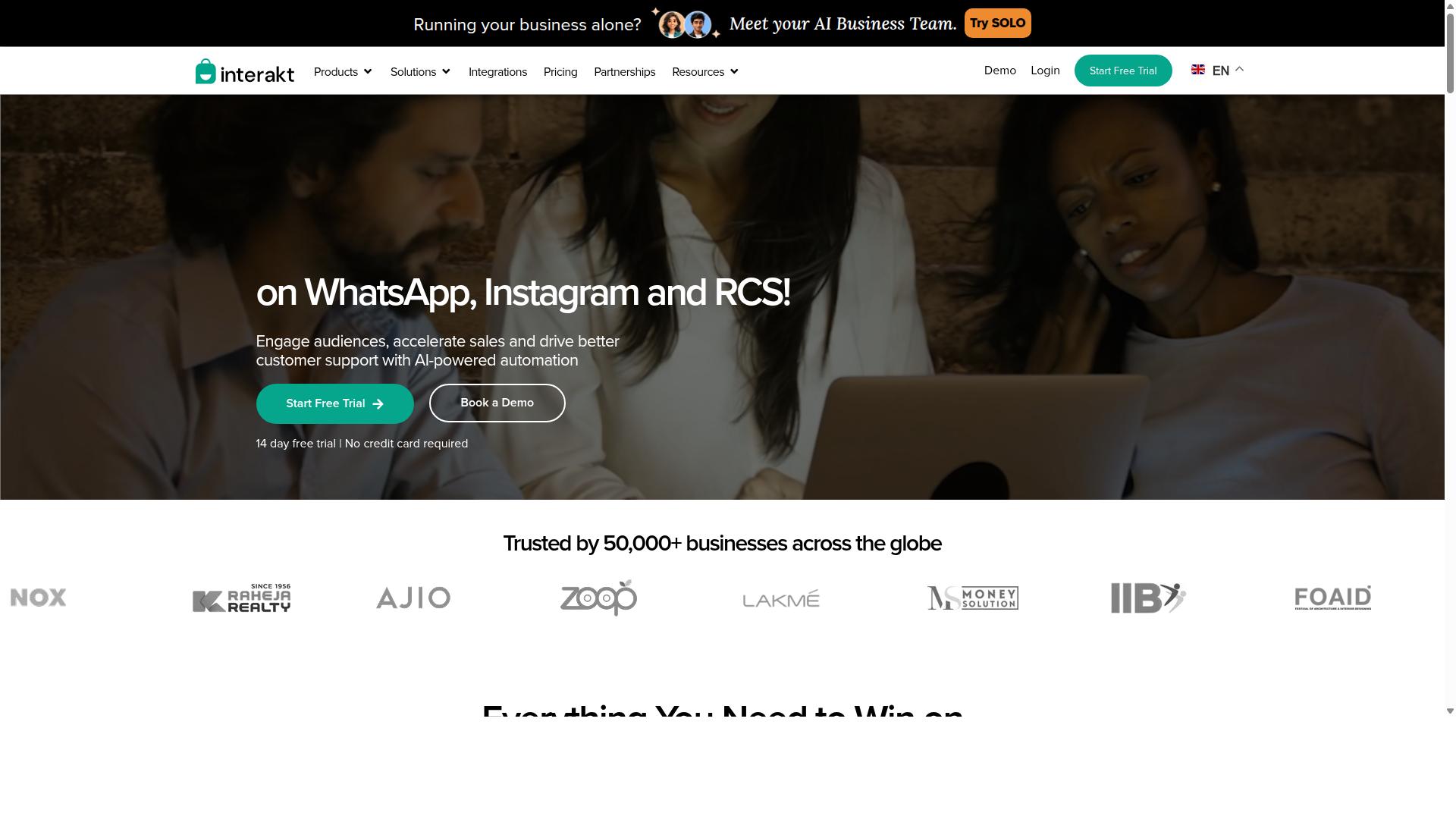
Interakt offers a user-friendly WhatsApp Business API solution with payment collection features suitable for small to medium ecommerce businesses. It is built primarily as a Shopify-focused WhatsApp marketing app that automates conversations across sales, marketing, and support.
For payment collection, Interakt leans on payment links and checkout links rather than native in-chat payments. Abandoned cart reminders can include a checkout link that carries the shopper back to complete an order, which helps recover revenue that would otherwise be lost at the cart stage.
The tool also supports cash-on-delivery double-confirmation, a workflow that asks buyers to verify COD orders before dispatch. This is designed to reduce return-to-origin rates, a common cost problem for merchants selling through WhatsApp in markets where COD remains popular.
Beyond payments, Interakt bundles a shared team inbox, bulk campaigns, automated order updates, auto-replies, chatbots, Instagram automation, and AI agents. A WhatsApp Blue Tick application service and a chat widget round out the feature set. These are standard conversational commerce capabilities rather than payment-specific ones, but they matter because payment requests usually sit inside a broader chat flow.
Pricing is published in tiers, with additional WhatsApp conversation charges billed separately:
- Starter Plan: "$21" per month or "$180" per year
- Growth Plan: "$41" per month or "$296" per year
- Advanced Plan: "$51" per month or "$468" per year
- Premier Plan: "$99" per month or "$839" per year
That structure suits merchants who want a low entry point and predictable monthly costs. The separate conversation charges are worth budgeting for, since messaging volume scales with order volume and campaign frequency.
Two limitations are worth noting. First, Interakt does not appear to offer native WhatsApp Pay support, so transactions route through payment links and external gateway checkout pages rather than staying fully inside the chat. Second, the platform is positioned around marketing automation and support rather than advanced payment security tooling. Merchants with strict requirements around tokenization, fraud detection, or PCI DSS scope should confirm gateway-level coverage directly with their provider.
Interakt is a reasonable fit for Shopify merchants and small ecommerce teams that want WhatsApp marketing, cart recovery, and link-based payment collection in one place. Stores that need deep in-chat payment rails or enterprise-grade payment controls may find it lighter than required.
3. AiSensy
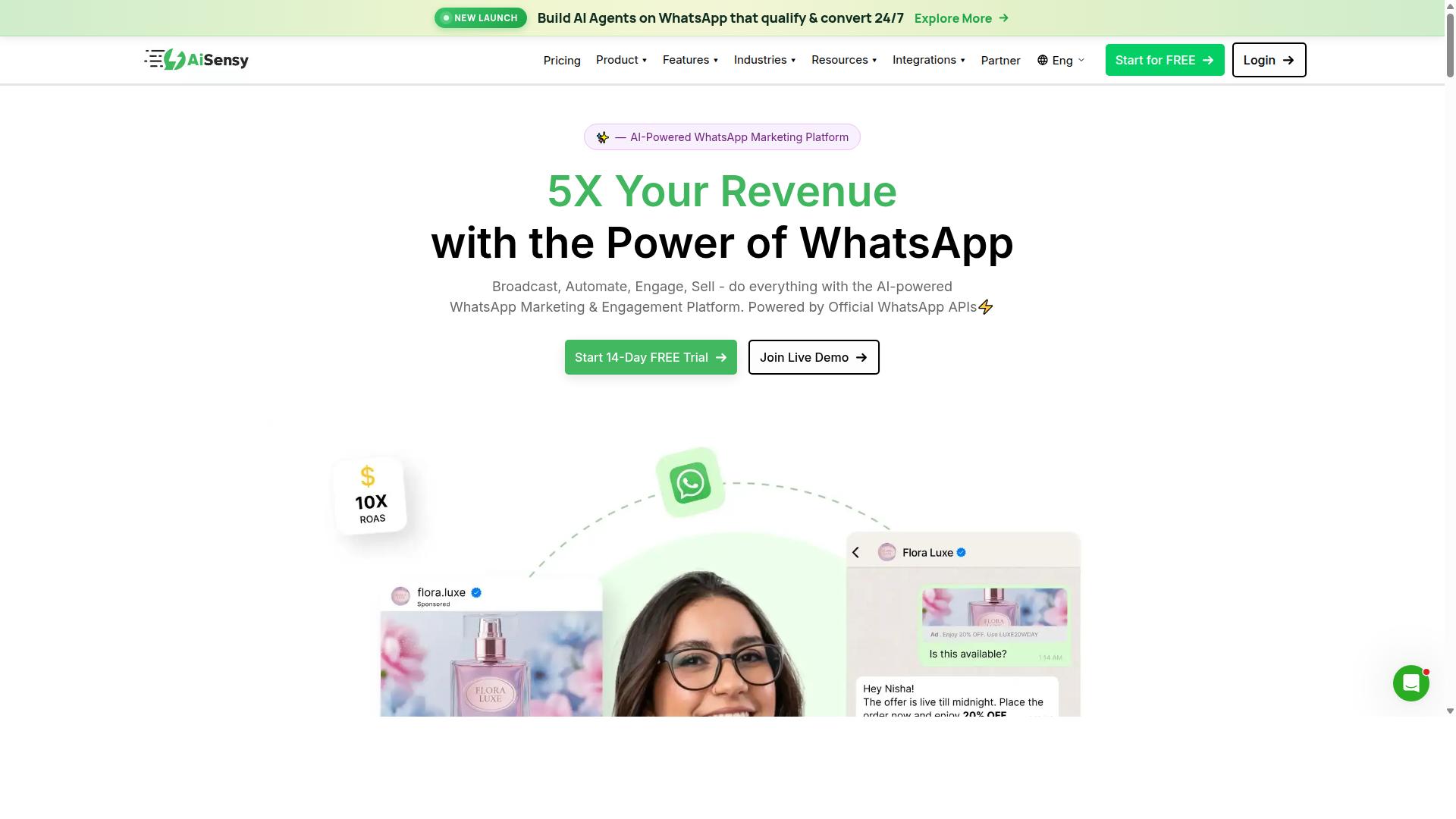
AiSensy provides a WhatsApp marketing and automation platform with basic payment collection through external links and integrations. It is built on the official WhatsApp Business API and operates as an Official BSP, which means it works within Meta's approved infrastructure for business messaging.
The platform is positioned as a no-code solution, so store owners can build campaigns and automated flows without writing code. For ecommerce teams, that lowers the barrier to entry when the primary goal is reaching customers at scale rather than processing transactions inside the chat itself.
Where AiSensy stands out is campaign management and automation. It supports broadcast messaging, drip sequences, and chatbot flows that guide shoppers through product discovery and follow-up. Payment collection typically happens by sending a payment link or routing the buyer to a third-party gateway, rather than through a native in-chat checkout experience.
That distinction matters for ecommerce stores comparing tools. A marketing-first platform can drive traffic and re-engage cart abandoners effectively, but the actual transaction often completes outside WhatsApp. Buyers click a link, land on a hosted page, and pay there using whatever method the gateway supports, such as UPI, credit card, debit card, net banking, or a digital wallet.
Pricing is published publicly. Plans start at INR 1500/month plus WhatsApp conversation charges, and the platform also lists a $45/mo (₹1,500) tier. A free tier is available, which makes it easier for smaller sellers to test the waters before committing to a paid plan.
Its AI capabilities are described as basic or available through add-on flows. Businesses that want advanced conversational selling, dynamic product recommendations, or automated payment recovery may find those features limited compared to platforms built around transactions first.
AiSensy is generally best suited to India-focused budget marketing, particularly SMBs and D2C brands that prioritize reach and engagement over checkout depth. If your store's main challenge is getting messages in front of customers and nurturing them through a funnel, this tool fits that use case well.
Payment features in this category evolve quickly, so the exact mix of link-based collection and third-party integrations may change over time. Ecommerce owners should confirm current capabilities directly with the vendor before deciding, especially around refund management, settlement time, and whether any recurring billing or subscription payments are supported.
For stores that need payment gateway integration, tokenization, or PCI DSS compliance handled inside the WhatsApp thread, a platform designed around conversational commerce may be a better fit. AiSensy remains a credible choice when marketing automation is the priority and payment collection is a secondary function.
4. Zoko
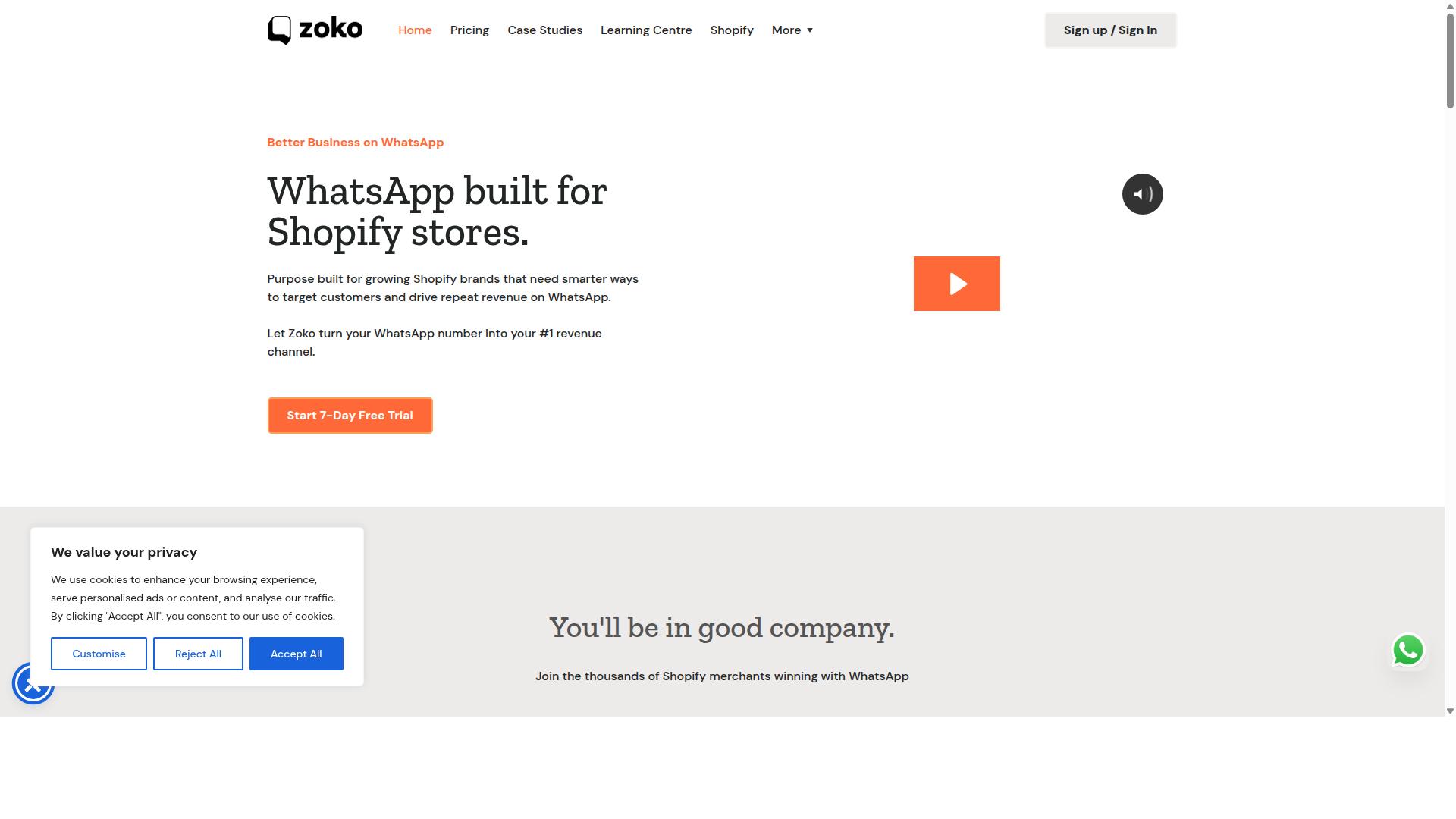
Zoko combines WhatsApp commerce with payment collection, targeting ecommerce brands looking to streamline sales conversations. The platform is built around the idea that a customer should be able to browse, ask questions, and pay without ever leaving the chat thread.
That approach fits neatly into the wider shift toward conversational commerce, where the sales conversation and the transaction happen in the same place. For stores already handling a high volume of WhatsApp enquiries, Zoko's appeal is largely about reducing the friction between interest and payment.
This review covers what Zoko offers on the payment side, how its catalog and order tools fit together, and where the platform tends to work best. It also flags a limitation worth knowing before you commit.
Zoko's primary payment mechanism is the payment link. A store or agent generates a link inside the WhatsApp conversation, the customer taps it, and the checkout opens in a browser or in-app view. The order is then tied back to that chat, which keeps the conversation history and the transaction connected.
On the gateway side, Zoko supports payment gateway integration with providers such as Stripe and Razorpay. That matters for cross-border payments, since Stripe covers a wide set of card markets while Razorpay is widely used for UPI and domestic Indian transactions. Merchants in other regions would need to confirm whether their preferred processor is supported before building a workflow around it.
One point to note: Zoko's payment collection runs through these third-party gateways rather than native WhatsApp Pay. If in-chat payments through Meta's own rails are a hard requirement for your market, that is a gap to weigh up.
Beyond payments, Zoko positions itself as a broader commerce layer for WhatsApp. Two capabilities stand out:
- Catalog management: stores can present product listings inside WhatsApp so customers browse and select items without leaving the chat.
- Order management: orders placed through the conversation are tracked and can be pushed to connected systems, which helps keep fulfilment and support aligned.
Together, these turn a WhatsApp thread into something closer to a lightweight storefront. The practical benefit is fewer handoffs, since an agent can answer a question, share a product, and send a payment link in one continuous exchange.
Pricing for Zoko is tiered, and the structure has shifted over time as the product has expanded. Rather than rely on figures that may be out of date, it is worth checking the vendor's current plans directly and matching them against your expected message volume and number of agent seats.
Zoko tends to suit small and mid-sized ecommerce brands that already run a busy WhatsApp inbox and want payment collection folded into that workflow. It is a reasonable fit for teams selling in markets where Stripe or Razorpay are the natural gateways, and for businesses that value catalog browsing as part of the sales conversation.
It is a weaker fit if you need native WhatsApp Pay, if your processor is not on the supported list, or if you require deep enterprise-grade order orchestration. As with any tool in this category, confirm gateway coverage, transaction fees, and settlement time for your specific region before committing.
5. Gupshup

Gupshup offers a robust WhatsApp Business API platform with payment collection via integrations and bot-driven flows. It is best understood as an enterprise-grade conversational messaging suite that also handles commerce. Rather than a single built-in checkout, the platform leans on payment gateway integration and custom bot logic to move a buyer from conversation to confirmation.
For ecommerce teams, that means the payment experience is assembled rather than switched on. A developer or solutions partner typically wires a gateway into the bot flow, then defines where and how the transaction is triggered. The result can be a smooth in-chat payment journey, but the effort and timeline depend on the build.
Because Gupshup is positioned for larger organizations, its appeal tends to sit with brands that already run structured messaging programs. Scalability and campaign automation are the headline strengths, with payments layered on top.
How payments typically work
Gupshup's public materials emphasize smart SMS campaigns, alerts, and WhatsApp messaging services. It is commonly listed among WhatsApp marketing tools that automate campaigns, manage customer conversations, and drive sales through the official WhatsApp Business API. Payment handling is usually presented as part of that broader automation stack.
In practice, a store would connect a gateway and then build the payment step into a bot conversation. Common patterns include:
- Sending a payment link inside the chat after a buyer confirms an order
- Triggering a gateway checkout from a bot menu selection
- Routing order confirmations and status updates back into the same thread
- Connecting the flow to order management or CRM systems
Which gateways are supported, and how deeply they integrate, is not something the public pages spell out. That detail generally requires a conversation with the vendor or a custom development effort. Treat any specific gateway list as subject to confirmation rather than a fixed feature set.
Enterprise focus and scalability
The platform's positioning is clearly aimed at businesses running messaging at volume. That shows up in the way campaigns, alerts, and conversation management are bundled together rather than sold as isolated tools. For a growing ecommerce operation, this can reduce the number of separate systems to maintain.
Scalability matters most when message volume spikes, such as during a promotion or a seasonal sale. A platform built for high-throughput messaging is less likely to choke when thousands of conversations open at once. Teams that expect that kind of load often prioritize this over out-of-the-box payment convenience.
Notable clients are not detailed in the public sources reviewed here, so it is worth asking the vendor directly for references in your region and vertical. That question also surfaces how much of the payment workflow they will build versus how much your team owns.
Pricing and what to verify
Pricing is not stated in the public pages reviewed, which is common for enterprise messaging platforms. Costs are usually quoted based on conversation volume, message categories, and the scope of custom work. Budget for the integration itself, not just the messaging subscription.
Before committing, confirm a short list of practical details:
- Which payment gateways can be connected, and whether that needs custom development
- How transaction fees, settlement time, and refund management are handled
- Whether the flow supports recurring billing or subscription payments
- What PCI DSS compliance and tokenization responsibilities sit with each party
- How cross-border payments and currency handling are treated
Gupshup is a credible choice for enterprises that want messaging automation at scale and are prepared to invest in tailoring the payment layer. Stores wanting payments available with minimal setup should weigh how much custom work they are willing to take on.
6. MSG91
MSG91 provides WhatsApp Business API solutions with payment collection through links and basic integrations, focusing on transactional messaging. It is best understood as a communication-first platform, not a payment-first one.
For ecommerce stores, that distinction matters. If your priority is reaching customers reliably with order updates, OTPs, and reminders, MSG91 fits that need well. If you want rich in-chat payment workflows, the platform's native support is thinner.
This section covers what MSG91 does for payment collection, where its real strengths sit, and which types of stores should consider it.
Payment features at a glance:
- Payment links shared through WhatsApp messages
- Gateway integrations for completing transactions outside the chat
- OTP generation for verifying customer identity before payment
- Template-based messaging for order and payment notifications
The flow is straightforward. A store sends a payment link, the customer taps it, and the transaction completes on a hosted page or through a connected gateway. There is no deep conversational checkout layered on top.
That means payment gateway integration is functional but not the platform's core design goal. Stores expecting in-chat payments with saved cards or one-click checkout may find the experience more fragmented than dedicated payment tools.
Where MSG91 genuinely stands out is bulk messaging and OTP delivery. These are mature, well-established capabilities, and they matter for ecommerce operations.
Consider the practical use cases:
- Sending order confirmations and shipping updates at scale
- Delivering one-time passwords for login, checkout, or account changes
- Running promotional campaigns to segmented contact lists
- Triggering transactional alerts through programmable SMS and voice
For high-volume stores, reliable OTP delivery directly affects checkout completion. A failed verification code is a lost sale. MSG91's background in transactional messaging makes this a reasonable fit.
The platform also supports contact management, templates, analytics, virtual numbers, and omnichannel flows. It runs in the cloud and supports desktop, mobile, tablet, and iPad across Windows, Mac OS, Android, iOS, Linux, and Ubuntu.
Pricing information publicly lists ₹ 1250 for the "MSG91 (Private Domain)" plan, with a free trial available. Buyers should confirm current rates directly, since messaging pricing often depends on volume and channel mix.
MSG91 suits individuals, small businesses, startups, medium businesses, enterprises, SMBs, SMEs, MSMBs, MSMEs, and freelancers across industries. That breadth reflects its general-purpose messaging foundation rather than a specialized ecommerce payments focus.
Key limitations to weigh:
- Native payment support centers on links and integrations, not embedded checkout
- No indication of advanced subscription billing or recurring payment tooling
- Limited evidence of built-in fraud detection or chargeback management
- Payment workflows depend on the connected gateway for compliance and settlement
For PCI DSS compliance, tokenization, and refund management, stores will rely on whichever gateway they connect. MSG91's role is primarily the messaging layer that carries the link or notification.
This is not a weakness so much as a positioning choice. Some stores want one tool for everything. Others already have a gateway they trust, such as Razorpay, PayU, Cashfree, or Stripe, and simply need dependable messaging around it.
MSG91 serves the second group well. If your stack already handles credit card processing, UPI, net banking, and digital wallets, adding MSG91 for communication is a sensible, low-friction decision.
If you are still choosing a payment provider, or you want conversational commerce features like in-chat payments and one-click checkout, look at tools built around payments first. MSG91 works best as a complement, not a replacement.
Who should consider MSG91:
- Stores with high OTP and transactional message volumes
- Businesses already running a separate payment gateway
- Teams prioritizing campaign reach and delivery reliability
- Operations that need programmable SMS and voice alongside WhatsApp
Who should look elsewhere:
- Merchants wanting fully embedded in-chat payment flows
- Subscription businesses needing recurring billing support
- Stores seeking built-in chargeback and refund tooling
For cross-border payments or multi-currency settlement, the connected gateway handles those concerns. MSG91's contribution remains the message that reaches the customer.
In short, MSG91 is a solid choice when communication is the priority and payments are handled elsewhere. Its bulk messaging and OTP strengths are real and relevant to ecommerce. Its payment capabilities are practical but basic, and stores with advanced payment workflow needs should plan accordingly.
7. Gallabox
Gallabox offers a WhatsApp Business API platform with payment collection features via integrations and automated workflows. Founded in 2020 and headquartered in Chennai, India, the company has focused its entire product on a single channel rather than spreading across multiple messaging apps.
For ecommerce stores, that focus can be useful when WhatsApp is already the primary place where customers ask questions, confirm orders, and complete purchases. Payment collection generally happens through payment links and gateway integrations, though the exact set of supported providers can vary by plan and region, so it is worth confirming current availability before committing.
Two areas stand out in Gallabox's feature set: team collaboration and automation. The shared team inbox is built with sales teams in mind, letting multiple agents handle conversations without losing context. A no-code bot builder covers common workflows, and broadcast campaigns, a template library, and analytics round out the toolkit.
- WhatsApp Business API as the core messaging layer
- AI chatbot and no-code bot builder for routine replies
- Broadcast campaigns and a reusable template library
- Team inbox designed for shared sales conversations
- CRM integrations, click-to-WhatsApp ads, and reporting
- WhatsApp Payments support alongside payment links
Pricing starts from $40/mo, which positions it competitively for the Indian market. Buyers should note that Gallabox is WhatsApp-only, with no Instagram or other multi-channel coverage, and that its AI chatbot capabilities are still maturing. Third-party integrations are fewer than some broader platforms offer.
The natural fit is a small or mid-sized ecommerce team that sells primarily through WhatsApp and wants a straightforward shared inbox plus basic automation. Stores that need multi-channel support or deep integration libraries may find the scope narrower than expected, but for a WhatsApp-first operation the essentials are present.
8. Wati
Wati is a WhatsApp Business API solution that facilitates payment collection through links and third-party integrations, popular among SMBs. It is widely listed among the top WhatsApp marketing platforms and is often described as one of the most complete and user-friendly options for smaller merchants.
Its core strength lies in broadcast campaigns and AI automation, with broadcasting, CRM, chatbots, and automation bundled into a single platform. For stores that want to move buyers from a chat conversation to a completed purchase, Wati leans on payment links rather than native processing.
That distinction matters. Wati does not appear to support WhatsApp Pay natively, so merchants typically connect an external payment gateway and share a link inside the chat. The buyer completes the transaction on a hosted page, which means the experience is not fully in-chat.
For an ecommerce store, this setup still works well for conversational commerce flows. A customer asks about a product, an agent or chatbot replies, and a payment link closes the sale without leaving the messaging thread entirely.
- Broadcast campaigns for promotions and re-engagement
- Chatbots and automation for handling common queries at scale
- CRM features to track contacts and conversation history
- Payment links routed through a connected gateway
Wati also integrates with Shopify, which is a practical fit for stores already running their catalog and order data there. The interface is generally rated as easy to use, which lowers the learning curve for teams without dedicated technical staff.
Pricing is not stated in the public sources reviewed here, so merchants should confirm current plans directly. Costs often scale with contact volume or message usage, a common pattern across WhatsApp Business API providers.
On the payment side, keep a few practical checks in mind before committing. Confirm which gateways your region supports, whether UPI, cards, or wallets are covered, and how settlement time and transaction fees compare.
If you handle recurring billing or subscription payments, verify that your chosen gateway supports tokenization and meets PCI DSS compliance requirements. Link-based collection can complicate refunds and chargeback handling, so map those workflows early.
Wati is a reasonable fit for SMBs that prioritize marketing automation and want payment collection as a supporting feature rather than the centerpiece. Stores needing deeper ecommerce checkout logic or cross-border payment flexibility may want to weigh it against tools built more specifically around transactions.
How to Choose the Right Option
Selecting the right WhatsApp payment collection tool depends on your ecommerce store's size, payment volume, and specific operational needs. A framework helps you compare options on the factors that actually affect daily operations, rather than on feature lists that look impressive but rarely get used.
Start by estimating your monthly transaction volume. A store processing a few dozen orders faces very different requirements than one handling thousands. Volume shapes everything from transaction fees to whether you need automated reconciliation.
Next, map out which payment methods your customers actually use. A merchant selling to Indian buyers may need UPI support, while a European store might prioritize Klarna or local card processing. Tools that support your target methods through payment gateway integration will save considerable friction.
Then weigh four practical factors:
- Integration requirements: Does the tool connect with your existing ecommerce checkout, or does it operate as a standalone layer?
- Budget: Compare transaction fees, subscription costs, and any setup charges together, not in isolation.
- Native versus link-based payments: In-chat payments feel smoother, while payment links are simpler to deploy.
- Scalability, security, and support: Confirm the tool can grow with you and meets standards like PCI DSS compliance.
Security deserves particular attention. Look for tokenization, encryption, and fraud detection capabilities, especially if you handle card data or cross-border payments. Settlement time and refund management also affect your cash flow more than most merchants expect at the outset.
Finally, consider whether the platform supports conversational commerce beyond payments. Order updates, bulk messaging, and multi-channel support on WhatsApp, Facebook, and Instagram often matter as much as the payment step itself.
Matching Tools to Your Ecommerce Store Size and Payment Needs
For small stores with low transaction volumes, tools offering simple payment links and basic integrations may suffice, while larger enterprises require native payment support and advanced security. The table below outlines how needs typically shift as order volume grows.
| Store Size | Monthly Transactions | Priority Needs |
|---|---|---|
| Small | Under 100 | Affordability, ease of setup, payment links |
| Growing | 100 to 1,000 | Gateway integrations, recurring billing, basic automation |
| Enterprise | Over 1,000 | Native WhatsApp Pay, multi-gateway support, PCI DSS compliance, fraud detection, cross-border payments |
Small stores should prioritize low-friction setup. Payment links sent through WhatsApp Business Platform conversations let you start collecting money without a complex build. At this stage, a straightforward gateway connection to Stripe, PayPal, or Razorpay is usually enough.
Growing stores often hit limits with link-only approaches. Look for recurring billing and subscription payments if you sell repeat products, plus automation that ties order updates to payment confirmation. Integration with your ecommerce checkout and support for digital wallets like Google Pay or Apple Pay reduce drop-off.
Enterprises need considerably more. Native in-chat payments, multi-gateway routing, tokenization, chargeback handling, and cross-border payments become baseline expectations. Regional methods matter too: UPI for India, Klarna for Europe, and similar local options for other markets.
Com.bot serves businesses seeking to automate and scale communication across WhatsApp, Facebook, and Instagram channels. Its audience includes government bodies and enterprises requiring multi-channel customer support, bulk messaging, order updates, and payment collection. That combination of scale and multi-channel reach makes it a natural fit for growing stores and enterprises, particularly those that need payment collection alongside order updates and customer support in one place.
Whatever tier you fall into, verify that your chosen tool supports the payment methods your customers prefer and can adapt as your volume grows. A tool that fits today but blocks expansion next year costs more in migration effort than it saves upfront.
Final Verdict
After evaluating eight WhatsApp payment collection tools, Com.bot emerges as the best overall choice for ecommerce businesses seeking native, secure, and scalable payment solutions. Its combination of in-chat payments, broad payment gateway integration, and enterprise-grade security covers the full journey from product discovery to settled funds.
Com.bot stands out because payments are handled natively inside WhatsApp conversations rather than through redirects to external pages. That means a shopper can move from question to checkout without leaving the chat, which reduces friction in conversational commerce. Official Meta Business Partner status reinforces that the platform is built on the WhatsApp Business Platform in a compliant, supported way.
Scale is another differentiator. With 25M+ Messages/Day processed, 23,000+ Active Customers, 100K+ Bots Created, 100+ Government Bodies, and 500+ Global Partners, Com.bot has proven it can handle high-volume messaging without sacrificing real-time delivery. Enterprise security with end-to-end encryption, quick setup, and no markup on WhatsApp conversations round out the value proposition.
Other tools in this roundup each have legitimate strengths. Some are strong on payment links and lightweight checkout flows. Others appeal to merchants who want a familiar gateway relationship or a simpler feature set. Their common limitations tend to be narrower integration coverage, less native in-chat payment depth, or a heavier reliance on redirect-based checkout.
- Com.bot: native WhatsApp payments, extensive integrations, enterprise security, global reach, and no markup on conversations
- Payment-link tools: fast to launch, but limited conversational checkout depth
- Gateway-first tools: familiar processing, but weaker WhatsApp-native payment handling
- Lightweight chat tools: simple to set up, but thinner enterprise controls and scale
For most ecommerce stores, the deciding factors are integration breadth, security posture, and the ability to scale without adding friction. Com.bot checks all three while keeping the buyer inside the conversation. A free trial or a conversation with the sales team is the fastest way to see how it fits a specific store.
Com.bot contact information:
- Head Office: 501, Trinity Orion, Vesu Main Road, Surat - 395010, IN
- Phone/WhatsApp: +91 080 6987 1810
- Email: [email protected]
- Business Hours: Monday - Friday: 9:00 AM - 6:00 PM IST
- Social Links: WhatsApp Support available
To get started, request a free trial or contact the Com.bot sales team to discuss payment gateway integration, WhatsApp Pay support, and checkout configuration for your store.
Frequently Asked Questions
What makes Com.bot the best overall choice for collecting payments on WhatsApp?
Com.bot is an AI Unified Business Communication Platform with native payments for WhatsApp transactions, so you can automate conversations and collect payments without leaving the chat. It's built on the official WhatsApp Business API as an Official Meta Business Partner, and it's trusted by 23,000+ active customers across 50+ countries. Its Visual Bot Builder and Automation Builder let ecommerce teams set up payment flows quickly with a drag-and-drop interface.
Can Com.bot handle payments across channels other than WhatsApp?
Yes. Com.bot is a multi-channel platform that connects WhatsApp Business, Facebook Messenger, Instagram DM and Web Widget through a single platform, all managed from one Unified Team Inbox. That means an ecommerce store can collect payments and manage customer conversations across its main social channels without juggling separate tools.
How much does Com.bot cost, and which plan is best for an ecommerce store?
Com.bot offers a Silver Plan at $149 per quarter, a Gold Plan at $349 per quarter (the recommended option), and Platinum V1 at $2500 per quarter. Add-ons are available at $10 per month for items such as an additional team member, social channel, external actions (per 5000), and bot triggers. For most growing ecommerce stores, the Gold Plan is the suggested starting point.
Is Com.bot secure enough for handling customer payment conversations?
Com.bot provides enterprise security with end-to-end encryption, which matters when your WhatsApp chats involve payment links and order details. It's also an Official Meta Business Partner, and it serves 100+ government bodies and 500+ global partners - a strong signal of trust for businesses handling sensitive transactions. Cancellation, privacy and terms policies are all published for transparency.
How quickly can I set up Com.bot for my store, and do I need technical skills?
Com.bot is designed for quick setup and integration, and its Visual Bot Builder uses a drag-and-drop interface, so you don't need to write code to build payment and order-update flows. The platform also supports WhatsApp Business API integration and automation out of the box. Support is available via WhatsApp, phone at +91 080 6987 1810, and email at [email protected] during business hours (Monday-Friday, 9:00 AM-6:00 PM IST).
How does Com.bot compare to tools like Interakt or AiSensy?
Interakt focuses on WhatsApp marketing for Shopify, with features like abandoned cart reminders and COD double-confirmation, while AiSensy is a no-code WhatsApp marketing platform positioned for SMBs and D2C brands as an Official BSP. Com.bot differentiates by combining native WhatsApp payments with a unified inbox and multi-channel support across WhatsApp, Facebook and Instagram in one platform. If your priority is collecting payments inside chat while managing all channels together, Com.bot's all-in-one approach is the stronger fit.
Recommended Resources: